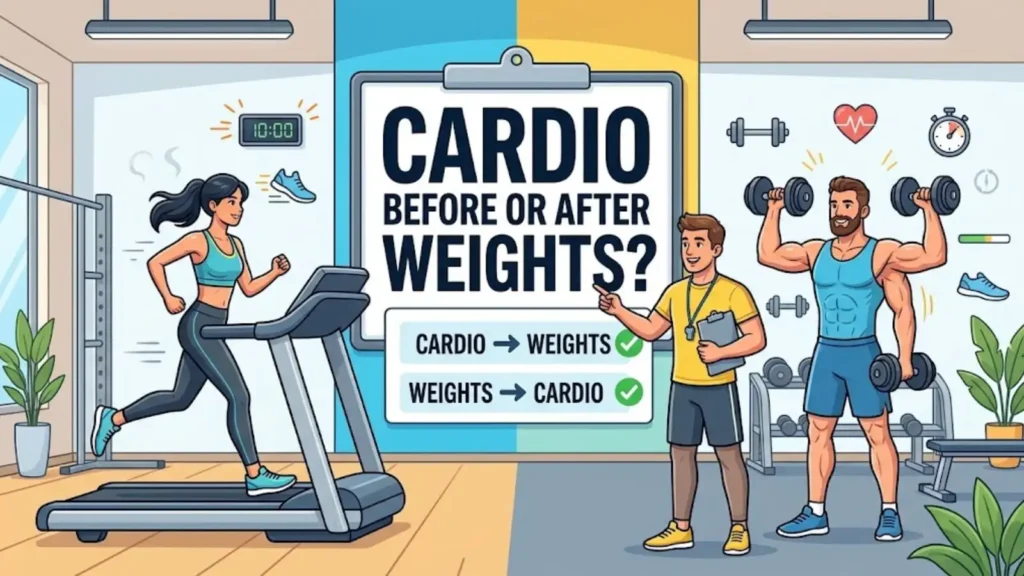
If you are wondering about cardio before or after weights, the best choice depends on your main fitness goal. your priority is building strength or muscle, doing weights first is usually the better option. If your main goal is improving endurance, cardio can come first. Research suggests that combining cardio and resistance training does not generally prevent muscle growth or maximal strength gains, although explosive-strength gains can be affected when both are performed very close together.
Quick Answer – Cardio Before or After Weights?
For most people focused on muscle growth, strength, or lifting performance, do weights before cardio. This lets you approach resistance exercises with more energy and focus. If endurance is your top priority, reverse the order and perform cardio first. You can also separate the workouts by several hours when your schedule allows.
Meaning of Cardio Before or After Weights
Cardio before or after weights simply asks about the order of aerobic and resistance exercises in the same workout. Cardio includes activities such as running, cycling, swimming, and brisk walking. Weights include dumbbells, barbells, machines, and other resistance exercises. Think of your workout as having two jobs: training your heart and training your muscles. The order can help you prioritize one job.
Simple Examples
- Weights → cardio: Better when strength is your main goal.
- Cardio → weights: Useful when endurance is your main goal.
- Separate sessions: Helpful when you want to train both seriously.
Why People Ask About Cardio Before or After Weights
People often wonder about cardio before or after weights because they do not want one type of exercise to reduce the benefits of another. A hard cardio session can leave your legs tired before squats, lunges, or deadlifts. On the other hand, lifting first may leave you with less energy for intense cardio.
Research on concurrent training shows that combining aerobic and resistance exercise generally does not significantly reduce muscle hypertrophy or maximal strength, although explosive-strength adaptations may be more sensitive when workouts occur in the same session.
Origin of the Terms Cardio and Weights
The word cardio is a shortened form of cardiovascular, referring to the heart and blood vessels. Cardiovascular comes from Latin cor or cordis, meaning “heart,” combined with vasculum, meaning “small vessel.”
The word weight comes from Old English wiht, referring to a thing or object, and developed into the modern sense of heaviness or a measured mass. In fitness, “weights” commonly refers to resistance-training equipment used to challenge muscles.
British vs American English
The phrase cardio before or after weights has the same meaning in British and American English. There is no spelling difference between the two varieties for these terms.
| Term | British English | American English |
|---|---|---|
| Cardio | Cardio | Cardio |
| Weights | Weights | Weights |
| Exercise | Exercise | Exercise |
| Strength training | Strength training | Strength training |
| Aerobic exercise | Aerobic exercise | Aerobic exercise |
So, whether you read a British fitness article or an American workout guide, the basic terminology remains consistent.
When to Do Cardio Before Weights
Choose cardio before weights when improving cardiovascular endurance is your main goal. For example, runners, cyclists, or people preparing for an endurance event may want to give their aerobic workout the most attention.
However, avoid turning your warm-up into a full workout before lifting. A short, easy cardio session can prepare your body without creating unnecessary fatigue. The goal is to arrive at your resistance exercises warm and ready, rather than exhausted.
When to Do Cardio After Weights
Choose cardio after weights when your main goal is building muscle or improving strength. Resistance exercises usually require greater force and concentration, so doing them first helps you give them your best effort.
A systematic review found that resistance followed by endurance exercise may benefit lower-body dynamic strength compared with the opposite order, although the difference was not consistent across every outcome.
Cardio Before or After Weights for Muscle Gain
If muscle growth is your priority, weights should usually come first. Resistance training provides the main stimulus for increasing muscle size, while cardio supports cardiovascular fitness.
Importantly, research does not show that adding aerobic exercise automatically prevents hypertrophy. A large meta-analysis found no significant reduction in muscle hypertrophy when aerobic and strength training were combined.
Cardio Before or After Weights for Fat Loss
For fat loss, the order matters less than your overall exercise routine, nutrition, recovery, and consistency. You can burn calories with both cardio and resistance training.
If you also want to preserve or build muscle while losing fat, putting weights first can be a practical strategy. It helps you prioritize resistance training rather than completing a demanding cardio session and then struggling through your lifts.
Cardio Before or After Weights for Strength
If you want to become stronger, perform your main resistance exercises before demanding cardio. Strength workouts require good technique, concentration, and force production.
This becomes especially important for heavy compound exercises such as squats, deadlifts, presses, and rows. Current resistance-training guidance also emphasizes performing important strength work early in the session when strength is the priority.
Cardio Before or After Weights for Endurance
If your primary goal is endurance, cardio can come first. This approach allows you to dedicate your freshest energy to running, cycling, rowing, swimming, or another aerobic activity.
For example, a runner training for a race may reasonably run before lifting. The key principle is simple: perform your highest-priority training first.
Common Mistakes
One common mistake is assuming that everyone must follow the same workout order. Your goals should determine the sequence.
Another mistake is doing extremely intense cardio immediately before heavy leg training. This can create fatigue and reduce your ability to perform quality resistance exercises.
Finally, do not assume that cardio and weights must always happen in the same session. When possible, separating demanding sessions can make recovery and performance easier.
Everyday Workout Examples
Here are a few practical combinations:
| Goal | Recommended Order | Example |
|---|---|---|
| Build muscle | Weights → cardio | Squats, presses → 20-minute walk |
| Build strength | Weights → cardio | Deadlifts, rows → easy cycling |
| Improve endurance | Cardio → weights | Running → light resistance training |
| General fitness | Either | Cardio + full-body weights |
| Explosive power | Prioritize power work | Jumps/strength → easy cardio |
The best plan is the one you can perform consistently while recovering well.
Usage Comparison Table
| Situation | Better Choice | Why |
|---|---|---|
| Building muscle | Weights first | Prioritizes resistance training |
| Increasing strength | Weights first | Helps preserve lifting performance |
| Improving endurance | Cardio first | Gives aerobic work your best energy |
| General health | Either order | Both forms of exercise provide benefits |
| Training for power | Power/weights first | Freshness supports explosive movements |
| Short workout | Goal first | Prioritize what matters most |
Can You Do Cardio and Weights on the Same Day?
Yes. Cardio and weights can be performed on the same day, especially for general fitness. Research indicates that concurrent training can support both aerobic and resistance adaptations without necessarily reducing muscle growth or maximal strength.
If both workouts are demanding, however, consider separating them by several hours or using different days. This can be particularly useful for athletes who care about power, speed, or high-level performance.
Should You Separate Cardio and Weights?
You do not always need to separate them. For recreational exercisers, combining them in one workout can be convenient and effective.
However, if you are training seriously for strength, power, or endurance performance, separating sessions may help you maintain better quality in each workout. Evidence suggests that short intervals between concurrent sessions may create more interference with some strength adaptations.
FAQs About Cardio Before or After Weights
Is cardio better before or after weights?
For muscle and strength, weights are generally the better first choice. For endurance, cardio can come first.
Does cardio after weights burn more fat?
Not necessarily. Fat loss depends mainly on overall energy balance, nutrition, activity, and consistency rather than simply placing cardio after lifting.
Can I do cardio and weights in the same workout?
Yes. Combining both is a common and effective approach for general fitness.
Does cardio ruin muscle gains?
No. Evidence suggests that concurrent aerobic and resistance training does not generally compromise muscle hypertrophy or maximal strength.
Should I do cardio before leg day?
If heavy leg strength is your priority, avoid doing a hard cardio workout immediately beforehand. Put weights first or separate the sessions.
How long should cardio last after weights?
There is no universal duration. A moderate 15–30 minute session can work well for many general-fitness routines, depending on your goals and recovery.
Is walking after weights a good idea?
Yes. Easy walking is a simple, low-impact way to add aerobic activity after resistance training without creating the same fatigue as hard intervals.
Conclusion
The answer to cardio before or after weights depends mainly on your goal. Choose weights first when strength or muscle growth matters most. Choose cardio first when endurance is your priority. For general fitness, either order can work.
Most importantly, do not overcomplicate your routine. Combine cardio, resistance training, recovery, and good nutrition in a way you can maintain consistently. If both sessions are intense, consider separating them to protect workout quality and recovery.