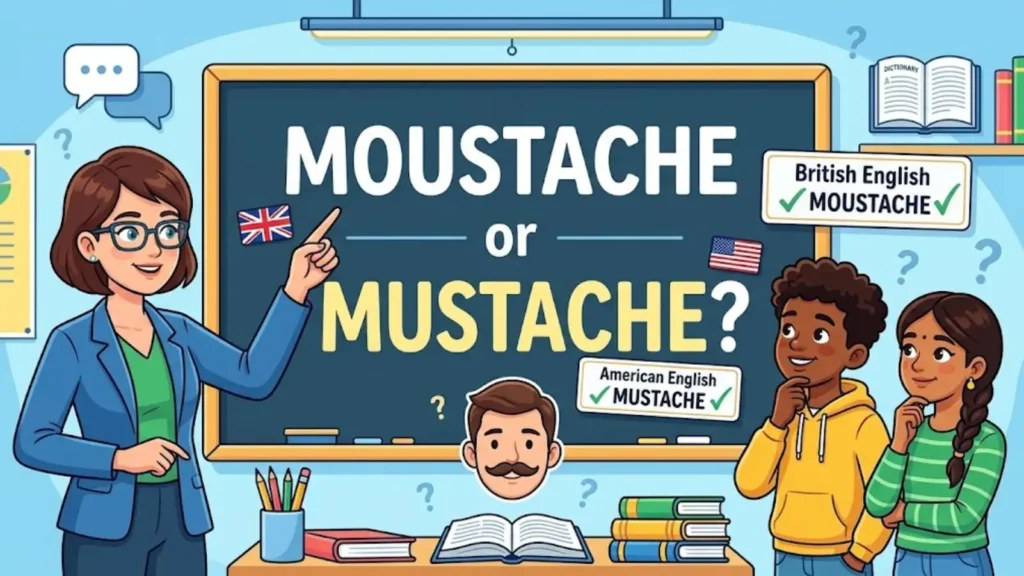
If you have ever wondered whether moustache or mustache is the correct spelling, you are not alone. Both forms are correct, but they are preferred in different varieties of English.
Moustache is the standard spelling in British English, while mustache is the usual spelling in American English. The two words have exactly the same meaning: the hair that grows above the upper lip.
For example, a British newspaper might write, “He grew a thick moustache,” while an American newspaper would usually write, “He grew a thick mustache.”
So, which spelling should you choose? The answer depends mainly on your audience and the style of English you are using.
Table of Contents
- Moustache or Mustache: Quick Answer
- What Does Moustache Mean?
- What Does Mustache Mean?
- Moustache vs Mustache: The Main Difference
- Origin and History
- British English vs American English
- Which Spelling Should You Use?
- Common Spelling Mistakes
- Everyday Examples
- Usage Trends and Popularity
- Comparison Table
- Special Rules and Related Words
- Frequently Asked Questions
- Conclusion
⚡ Moustache or Mustache: Quick Answer
Moustache and mustache are both correct spellings.
- Moustache is mainly used in British English.
- Mustache is mainly used in American English.
- Both words refer to hair growing above the upper lip.
- The meaning does not change between the two spellings.
- Choose moustache for British-style writing.
- Choose mustache for American-style writing.
Cambridge Dictionary identifies moustache as mainly British and mustache as the usual American spelling.
Correct: He has a neatly trimmed moustache.
Correct: He has a neatly trimmed mustache.
Neither spelling is wrong.
<a name=”meaning”></a>
What Does Moustache Mean?
Moustache is a noun that means the hair growing above a person’s upper lip.
It commonly refers to facial hair that someone deliberately grows and styles. A moustache can be thin, thick, short, long, straight, curled, or bushy.
For example:
- My grandfather had a thick moustache.
- He decided to grow a moustache.
- The actor wore a fake moustache for the role.
- She noticed that her brother had shaved his moustache.
The word can also appear in compounds such as handlebar moustache and walrus moustache.
Is Moustache a Noun?
Yes. Moustache is primarily a noun.
It names the facial hair above the upper lip.
Example:
Daniel trimmed his moustache before the wedding.
The plural form is moustaches.
Several men at the festival had impressive moustaches.
<a name=”mustache”></a>
What Does Mustache Mean?
Mustache has exactly the same meaning as moustache.
It describes hair that grows above the upper lip. The major difference is spelling rather than meaning.
The spelling mustache is especially common in American English. Cambridge lists it as the US spelling of the mainly British moustache.
Examples include:
- My uncle has a gray mustache.
- He shaved his mustache yesterday.
- The detective had a large mustache.
- His mustache made him look older.
So, if you are writing for an American audience, mustache is usually the safer choice.
<a name=”difference”></a>
Moustache vs Mustache: What Is the Difference?
The biggest difference is regional spelling.
There is no meaningful difference in definition. Both words describe the same type of facial hair.
Think of the difference as similar to other British-American spelling pairs, such as:
- colour / color
- favourite / favorite
- centre / center
- organise / organize
- moustache / mustache
The first forms are generally associated with British English, while the second forms are generally associated with American English.
Moustache
Moustache is mainly the British spelling.
Example:
James has grown a stylish moustache.
Mustache
Mustache is mainly the American spelling.
Example:
James has grown a stylish mustache.
Both sentences are grammatically correct.
<a name=”origin”></a>
Origin and History of Moustache and Mustache
The history of this word is surprisingly long.
The English word ultimately traces back through French and Italian to Greek. Etymonline records mustache/moustache from French moustache, which came from Italian mostaccio and ultimately from Medieval Greek moustakion, related to Greek mystax, meaning the upper lip or moustache.
French historical sources also connect moustache with Italian mostaccio and Greek forms referring to the upper lip.
The word entered English centuries ago. Interestingly, older English usage sometimes treated the term as plural, which helps explain forms such as mustachios found in historical writing.
Over time, English settled into the two familiar modern spellings:
moustache and mustache.
The British form retained the ou, while American English commonly adopted the shorter u spelling.
<a name=”british-american”></a>
British English vs American English
This is where the spelling difference becomes easiest to understand.
British English
British English generally prefers:
moustache
Example:
He has a thick black moustache.
British dictionaries commonly identify moustache as the standard UK form.
American English
American English generally prefers:
mustache
Example:
He has a thick black mustache.
Cambridge identifies mustache as the US spelling.
What About Canada and Other Countries?
English spelling can vary by country, publication, and personal preference. Some English-speaking regions may use either form.
Therefore, the safest approach is to follow the spelling style used by your publication, school, workplace, or target audience.
<a name=”which”></a>
Which One Should You Use?
The easiest rule is simple:
Use the spelling that matches your variety of English.
Choose moustache when:
- You are writing in British English.
- Your audience is mainly in the UK.
- Your publication follows British spelling.
- You are maintaining British spelling throughout an article.
Choose mustache when:
- You are writing in American English.
- Your audience is mainly in the United States.
- Your publication follows American spelling.
- You are targeting American search traffic.
A Useful Writing Tip
Consistency matters more than choosing one spelling as universally correct.
If your article uses American English, write:
The actor grew a mustache for the movie.
Do not randomly switch to:
The actor grew a moustache for the movie.
Likewise, British-style content should normally stay with moustache.
<a name=”mistakes”></a>
Common Spelling Mistakes
Because the two spellings look almost identical, writers sometimes mix them within the same article.
❌ Incorrect for Consistent American English
He grew a moustache last year.
✅ Better for American English
He grew a mustache last year.
❌ Incorrect for Consistent British English
He grew a mustache last year.
✅ Better for British English
He grew a moustache last year.
Notice that these examples are not about grammar. They are about regional spelling consistency.
Another Common Mistake
Some writers add unnecessary letters:
❌ mustachee
❌ moustachee
❌ moustash
Correct forms:
✅ mustache
✅ moustache
<a name=”examples”></a>
Moustache or Mustache: Everyday Examples
Seeing both forms in context makes the difference much easier to remember.
1. In an Email
British English:
Hi James, I noticed your new moustache. It looks great!
American English:
Hi James, I noticed your new mustache. It looks great!
2. On Social Media
A British user might write:
Finally decided to grow a moustache!
An American user might write:
Finally decided to grow a mustache!
3. In the News
British-style reporting may use:
The actor appeared with a neatly trimmed moustache.
American-style reporting may use:
The actor appeared with a neatly trimmed mustache.
4. In the Classroom
A teacher might explain:
Moustache is the common British spelling.
For an American English lesson, the teacher could say:
Mustache is the common American spelling.
5. In Daily Conversation
You might hear:
Your moustache looks different.
Or:
Your mustache looks different.
Both sentences communicate the same idea.
<a name=”trends”></a>
Which Spelling Is More Common?
Usage depends strongly on location.
Moustache is strongly associated with British English, while mustache is strongly associated with American English. Cambridge explicitly labels the former mainly UK and the latter US.
Therefore, there is no single spelling that should be considered universally better.
If your website targets readers in the United States, mustache is usually the better SEO and style choice.
If your website targets British readers, moustache is the natural choice.
For international websites, you can mention both forms naturally. However, avoid repeating both spellings in every paragraph simply to capture search variations.
<a name=”table”></a>
Moustache vs Mustache: Comparison Table
| Feature | Moustache | Mustache |
|---|---|---|
| Meaning | Hair above the upper lip | Hair above the upper lip |
| Spelling | British English | American English |
| Pronunciation | Same basic word | Same basic word |
| Part of speech | Noun | Noun |
| Plural | Moustaches | Mustaches |
| Main usage | UK and British-style English | US and American-style English |
| Is it correct? | Yes | Yes |
| Example | He has a moustache. | He has a mustache. |
The key point is simple: the meaning stays the same; the spelling changes by English variety.
<a name=”rules”></a>
Special Rules and Related Uses
The word can appear in several useful expressions.
Handlebar Moustache / Handlebar Mustache
A handlebar moustache or handlebar mustache is a style with ends that curve upward.
Example:
He grew an impressive handlebar mustache.
Walrus Moustache / Walrus Mustache
This describes a very thick, hanging style that resembles a walrus’s facial hair.
Example:
His enormous walrus moustache attracted everyone’s attention.
Fake Moustache / Fake Mustache
A fake version is often used for costumes, comedy, theater, or disguises.
Example:
The children wore fake moustaches at the party.
Moustached / Mustached
The adjective forms can also vary.
For example:
The moustached actor entered the room.
In American English:
The mustached actor entered the room.
<a name=”faqs”></a>
Frequently Asked Questions
Is moustache or mustache correct?
Both moustache and mustache are correct. Moustache is mainly the British spelling, while mustache is mainly the American spelling.
Is moustache British or American?
Moustache is mainly British English. American English generally uses mustache.
Is mustache American English?
Yes. Mustache is the standard American spelling, although Americans may also encounter moustache.
Do moustache and mustache mean the same thing?
Yes. Both words refer to hair that grows above the upper lip. The difference is primarily regional spelling.
How do you spell moustache in American English?
In American English, the usual spelling is mustache, without the letter o after the m.
How do you spell mustache in British English?
The common British spelling is moustache, with ou after the initial m.
Which spelling should I use for an American audience?
Use mustache if you are following standard American English. It is the spelling most naturally expected by US readers.
<a name=”conclusion”></a>
Conclusion
So, moustache or mustache—which one should you choose?
The answer is straightforward: both are correct.
Use moustache when writing in British English, and use mustache when following American English. The two spellings have the same meaning and refer to hair growing above the upper lip.
The best habit is to stay consistent. If your article follows American spelling, use mustache throughout. If it follows British spelling, choose moustache.
Once you remember the regional difference, this spelling question becomes much less hairy.

Hi, I’m Alex Reed, the voice behind Grammar Meaning! I simplify English grammar into easy lessons. I write for basicsgrammar.com to help you improve daily writing.