English learners often confuse at the end and in the end because both phrases contain the same noun and sound very similar. However, they perform different jobs in a sentence. Understanding the small difference between these expressions can make your writing much clearer.
Quick Answer: At the End vs In the End
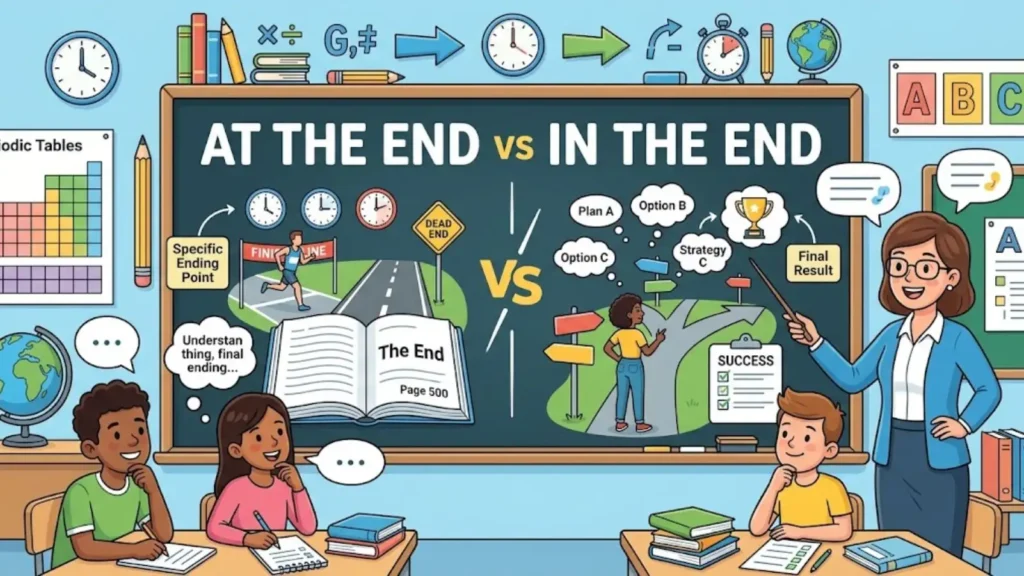
At the end refers to a specific point, place, event, or period when something finishes. For example, “We talked at the end of the meeting.”
In the end means finally, ultimately, or after everything was considered. For example, “We discussed several options, but in the end, we chose the first one.” Cambridge Grammar makes the same distinction: at the end points to when something finishes, while in the end describes a final result after a process or series of events.
Easy rule: Think at = a point and in = a final result.
Meaning of At the End and In the End
At the end normally identifies the final part of something specific. It can describe time, location, events, or abstract situations.
- We met at the end of the street.
- She cried at the end of the movie.
- I felt tired at the end of the day.
- He was at the end of his patience.
In the end usually describes a final decision, result, or conclusion. It often follows uncertainty, disagreement, effort, or several events.
- In the end, we agreed.
- She tried several jobs and in the end found one she loved.
- In the end, everything worked out.
The key difference is specific ending versus final outcome.
Why People Confuse At the End and In the End
People confuse these expressions because only one small word changes: at becomes in. Both phrases contain the same words, and both can relate to something finishing.
However, the prepositions create a different meaning. English learners sometimes translate these expressions directly from their first language, which can lead to unusual combinations.
Another common mistake is treating in the end as if it were simply another version of at the end of. It is not. For example:
- ✅ At the end of the lesson, we took a quiz.
- ❌ In the end of the lesson, we took a quiz.
- ✅ We had several choices, but in the end, we stayed home.
The problem is therefore preposition choice, not spelling.
Origin of the Keyword
The word end has a very old history. It comes from Old English ende, meaning “end, conclusion, boundary, or district.” It is related to the Proto-Germanic form andiaz and ultimately to a Proto-Indo-European root associated with an end or boundary.
The Latin word finis also means “end,” “boundary,” or “limit.” It gave English words such as finish through Old French and Latin finire, meaning “to limit” or “bring to an end.”
Over time, English developed many expressions containing end, including at the end, in the end, and at the end of the day.
British vs American English
There is no spelling difference between at the end and in the end in British and American English. Both varieties use the same expressions with essentially the same meanings.
| English Variety | At the End | In the End |
|---|---|---|
| British English | Correct | Correct |
| American English | Correct | Correct |
| Meaning | Specific ending point | Final result |
| Spelling difference | None | None |
For example, British and American writers can both say, “At the end of the meeting, everyone left.” They can also say, “In the end, we accepted the proposal.”
When to Use At the End
Use at the end when you can identify a specific thing that reaches its final point. It commonly appears with of + noun.
Essays and assignments
- At the end of the essay, the writer summarizes the argument.
- Add your references at the end of the assignment.
Emails and reports
- Please sign the document at the end of the report.
- I added my contact details at the end of the email.
Work and legal documents
- The parties signed the agreement at the end of the meeting.
- The terms appear at the end of the document.
Casual writing
- We went for coffee at the end of the movie.
- Everyone laughed at the end of the story.
When to Use In the End
Use in the end when you mean finally, ultimately, or after everything was considered.
It often describes a conclusion that comes after a process.
- We considered three hotels, but in the end, we booked the cheapest one.
- She was nervous about the interview but in the end, she got the job.
- They argued for hours and in the end, reached an agreement.
- I did not want to go, but in the end, I changed my mind.
Cambridge describes this use as a conclusion reached after a long process, changes, or discussion.
Common Mistakes
The most common mistake is replacing at with in when referring to a specific ending.
| Incorrect | Correct |
|---|---|
| ❌ In the end of the movie, she cried. | ✅ At the end of the movie, she cried. |
| ❌ We talked in the end of the class. | ✅ We talked at the end of the class. |
| ❌ At the end, we finally chose Paris. | ✅ In the end, we finally chose Paris. |
| ❌ In the end of the street is a shop. | ✅ At the end of the street is a shop. |
Remember that at the end of + noun is the usual structure when you identify what is ending.
What About Double “S”?
Unlike words such as address and success, this topic does not involve a double-“s” spelling rule. Both at the end and in the end are already correctly spelled.
Typing quickly can still cause errors, such as:
- ❌ at teh end
- ❌ in teh end
- ❌ atend
- ❌ inthe end
Slow down for a second and check the preposition, not the spelling of end.
At the End vs In the End: Everyday Examples
These expressions appear frequently in everyday communication.
Emails
At the end:
“Please add your signature at the end of the email.”
In the end:
“We discussed the schedule, but in the end, we postponed the meeting.”
Social Media
At the end:
“Wait until the end of the video!”
In the end:
“I wanted to quit, but in the end, I finished the challenge.”
Professional Writing
At the end:
“The manager answered questions at the end of the presentation.”
In the end:
“Several solutions were considered, but in the end, the team chose option B.”
School Assignments
At the end:
“Write your conclusion at the end of the essay.”
In the end:
“In the end, the character learns an important lesson.”
Usage Comparison Table
| Context | Correct Expression | Example |
|---|---|---|
| Object/location | At the end | The shop is at the end of the street. |
| Skill or ability | In the end | In the end, she learned how to solve the problem. |
| Legal document | At the end | The signatures appear at the end of the contract. |
| Legal outcome | In the end | In the end, the parties reached an agreement. |
| Movie or book | At the end | There is a surprise at the end of the movie. |
| Final result | In the end | In the end, we chose the blue car. |
| Daily speech | At the end | We talked at the end of class. |
| Final decision | In the end | In the end, I decided to stay. |
A Simple Trick to Remember the Difference
Use this memory trick:
AT = a point.
IN = an outcome.
Imagine standing at a finish line. You are physically or mentally pointing to a specific ending point.
Now imagine looking back after a long journey. In the end, you are talking about what finally happened.
Compare:
At the end of the race, everyone was exhausted.
This identifies a specific moment.
In the end, Sarah won the race.
This identifies the final result.
This simple contrast can help you choose the right phrase quickly.
Is “At the End of the Day” Different?
Yes. At the end of the day can have a literal meaning, but it is also a common idiom meaning ultimately or when everything is considered.
For example:
At the end of the day, we need to make a decision.
Here, nobody necessarily means sunset or evening. The expression introduces the speaker’s final point or most important consideration.
So, at the end of the day can sometimes function similarly to in the end, even though their basic structures differ.
FAQs About At the End vs In the End
Is “at the end” correct?
Yes. At the end is correct when you refer to a specific final point, location, event, or period.
Is “in the end” correct?
Yes. In the end is correct when you mean finally, ultimately, or after everything was considered.
What is the easiest way to remember them?
Remember at = point and in = result. Use at the end of for a specific thing and in the end for a final outcome.
Can I say “in the end of the movie”?
Usually, no. Say at the end of the movie when you mean the final part of the movie.
Can I say “at the end, we decided”?
It can be grammatical in some contexts, but in the end is normally better when you mean the final decision or outcome.
Are these phrases different in British and American English?
No major difference exists. At the end and in the end are used in both British and American English.
Is “at the end” an idiom?
It can be part of several fixed expressions, but its basic use is a normal prepositional phrase referring to a final point or position.
Conclusion
At the end vs in the end is mainly a question of meaning, not spelling. Use at the end for a specific final point, location, event, or period. Use in the end when discussing a final result, conclusion, or decision.
For example, say “at the end of the meeting” but “in the end, we agreed.” Also remember that the expressions do not depend on a double-“s” spelling rule. Once you connect at with a point and in with an outcome, choosing the right phrase becomes much easier.

Hi, I’m John Miles, the voice behind Grammar Meaning! I share clear and practical grammar tips. You’ll find my work on basicsgrammar.com.