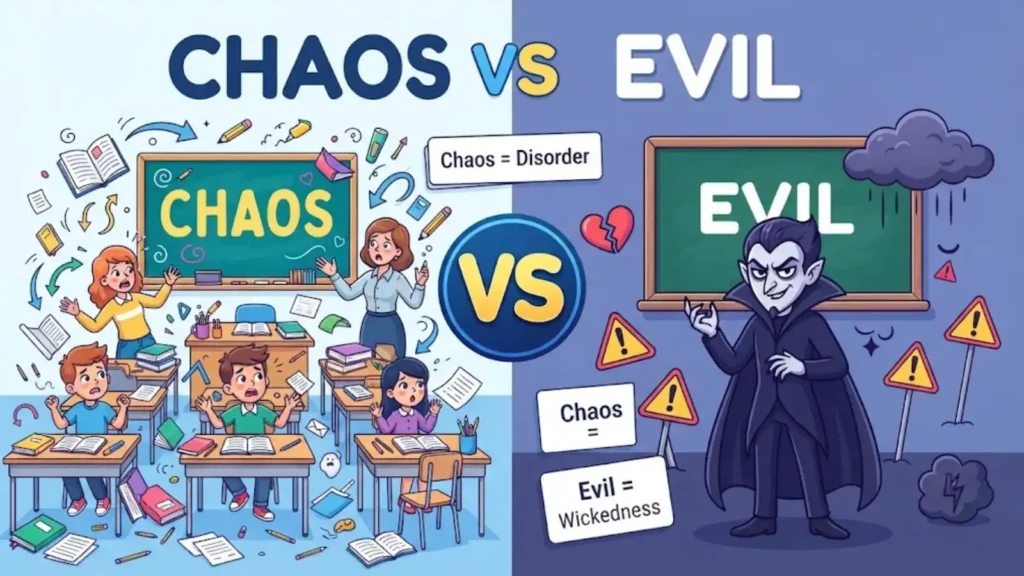
Chaos means complete disorder, while evil describes something morally wrong, cruel, or wicked. Although these words often appear in negative situations, they express very different ideas.
Imagine a classroom where students shout, books cover the floor, and nobody follows the teacher’s instructions. The room is in chaos. Now imagine someone deliberately bullying another student and enjoying their suffering. That behavior is evil.
Both situations are unpleasant, but their meanings are not the same.
RELATED: Break Metal or Brake Metal: Understanding the Correct Usage
Table of Contents
- Chaos vs Evil – Quick Answer
- What Does Chaos Mean?
- What Does Evil Mean?
- Origin and History of Both Words
- British English vs American English
- Which One Should You Use?
- Common Mistakes
- Everyday Examples
- Usage Trends and Popularity
- Chaos vs Evil Comparison Table
- Special Rules and Important Uses
- Frequently Asked Questions
- Conclusion
Chaos vs Evil – Quick Answer
Chaos means a state of complete confusion, disorder, or lack of organization. Evil means something extremely bad, immoral, cruel, or harmful.
Here is the simplest way to remember the difference:
- Chaos: A situation without order or organization.
- Evil: A person, action, or force associated with serious wrongdoing.
Examples:
- The unexpected announcement caused chaos throughout the school.
- The villain used his power for evil purposes.
Therefore, use chaos when discussing disorder and evil when discussing wickedness or moral wrongdoing.
What Does Chaos Mean?
Chaos is a noun that describes a situation where everything seems disorganized, confused, or out of control.
It often refers to situations where people cannot maintain order or follow a clear plan.
For example, imagine a busy airport where flights are delayed, passengers are arguing, and announcements keep changing. That situation can easily become chaotic.
Examples of Chaos in Sentences
- The sudden storm created chaos across the city.
- The children’s birthday party turned into complete chaos.
- Nobody knew what to do during the emergency, so confusion and chaos spread.
- The office was in chaos after several employees resigned.
- Heavy traffic caused chaos during the morning rush.
Common Words Related to Chaos
- Disorder
- Confusion
- Turmoil
- Disorganization
- Mayhem
- Uproar
- Turbulence
Important: Chaos does not automatically mean something is evil. A messy room, unexpected traffic, or a crowded classroom can create chaos without involving immoral behavior.
What Does Evil Mean?
Evil can function as both a noun and an adjective. It describes something morally wrong, extremely harmful, cruel, or wicked.
Unlike chaos, evil focuses on morality and harmful behavior rather than organization.
For example, a person who deliberately hurts innocent people for personal pleasure may be described as evil.
Examples of Evil in Sentences
- The story describes a powerful king who became completely evil.
- The criminal committed an evil act against innocent people.
- The movie explores the eternal struggle between good and evil.
- The villain wanted to spread evil throughout the kingdom.
- She believed that kindness could overcome evil.
Common Words Related to Evil
- Wickedness
- Cruelty
- Immorality
- Malice
- Corruption
- Malevolence
- Villainy
Important: Evil usually involves serious moral wrongdoing. However, people sometimes use it figuratively to describe something extremely unpleasant, such as an evil smell.
Origin and History of Both Words
Understanding word origins helps explain why chaos and evil have different meanings.
Origin of Chaos
The word chaos comes from the ancient Greek word khaos, which referred to an abyss, emptiness, or vast open space.
It entered English through Latin and Old French during the late Middle English period.
Originally, the word described a formless state or empty space associated with ancient creation stories.
Over time, its meaning developed to include confusion, disorder, and disorganization. Today, people use it for everything from messy bedrooms to major public disturbances.
The related adjective chaotic describes something full of confusion or disorder.
Origin of Evil
The word evil comes from Old English yfel, which referred to something bad, harmful, or morally wrong.
It has Germanic roots and is related to Dutch euvel and German Übel.
Throughout English history, the word developed strong connections with wickedness, cruelty, immorality, and harmful behavior.
Today, evil appears in discussions about morality, religion, literature, crime, and human behavior.
British English vs American English
There is no spelling difference between chaos and evil in British and American English.
Both varieties use exactly the same spellings and meanings.
| Word | British English | American English |
|---|---|---|
| Chaos | Chaos | Chaos |
| Evil | Evil | Evil |
| Chaotic | Chaotic | Chaotic |
| Evildoer | Evildoer | Evildoer |
However, pronunciation can vary slightly between accents.
For example:
- Chaos: British and American pronunciations have slightly different vowel sounds.
- Evil: Both varieties generally pronounce the word similarly.
Therefore, you can confidently use both words in British and American writing.
Which One Should You Use?
Choosing between chaos and evil depends on what you want to describe.
Use chaos when discussing:
- A messy or disorganized situation.
- Confusion during an emergency.
- Uncontrolled crowds or public disturbances.
- A situation without clear leadership.
- Unexpected events that disrupt normal activities.
Use evil when discussing:
- Cruel or immoral behavior.
- Wicked characters in stories.
- Deliberate harm against innocent people.
- Serious moral wrongdoing.
- Harmful forces in religious or philosophical discussions.
Compare These Examples:
- The unexpected power failure caused chaos in the hospital.
- The criminal’s deliberate actions revealed his evil intentions.
The first sentence describes confusion. The second describes harmful intentions.
Common Mistakes
English learners sometimes use chaos and evil as if they were interchangeable. However, their meanings are different.
Here are some mistakes to avoid.
| Incorrect Usage | Correct Usage | Explanation |
|---|---|---|
| His evil room was full of clothes. | His room was in chaos. | A messy room describes disorder. |
| The traffic was full of evil. | The traffic was chaotic. | Traffic problems create confusion. |
| The villain created chaos through cruel actions. | The villain used evil methods. | Evil describes wicked behavior. |
| Her evil schedule confused everyone. | Her chaotic schedule confused everyone. | A disorganized schedule is chaotic. |
Remember: Chaos describes the condition of a situation, while evil describes moral wrongdoing or something extremely harmful.
Everyday Examples of Chaos and Evil
Both words appear in everyday English, but their contexts are different.
1. Emails
Chaos:
“The office is in chaos because several important files are missing.”
Evil:
“The manager condemned the employee’s evil actions against his colleagues.”
2. Social Media
Chaos:
“The unexpected announcement created chaos across social media.”
Evil:
“People criticized the evil behavior shown in the viral video.”
3. News Reports
Chaos:
“Heavy rainfall caused chaos on several major roads.”
Evil:
“The court condemned the evil actions committed against innocent victims.”
4. Classroom
Chaos:
“The classroom descended into chaos when the teacher left.”
Evil:
“The story’s evil character tried to frighten everyone.”
5. Daily Life
Chaos:
“My morning became chaotic when I missed the bus and lost my keys.”
Evil:
“Deliberately hurting someone who trusts you is a cruel and evil act.”
These examples show that both words describe negative ideas, but they serve different purposes.
Usage Trends and Popularity
Both chaos and evil are established English vocabulary words. However, they appear in different types of writing and conversations.
How People Use Chaos
The word chaos frequently appears in:
- News reports about emergencies and public disturbances.
- Workplace discussions about disorganization.
- Social media posts describing confusing situations.
- Fiction involving unpredictable events.
- Scientific discussions about chaos theory.
It is also common in everyday expressions such as complete chaos, total chaos, and chaotic situation.
How People Use Evil
The word evil frequently appears in:
- Religious and philosophical discussions.
- Crime reporting and moral debates.
- Horror movies and fantasy stories.
- Discussions about cruelty and injustice.
- Literature involving heroes and villains.
Common expressions include good and evil, evil intentions, evil deeds, and necessary evil.
Although both words remain common, neither replaces the other. Their popularity depends on the subject and context.
Chaos vs Evil Comparison Table
The following table summarizes the most important differences.
| Feature | Chaos | Evil |
|---|---|---|
| Meaning | Disorder and confusion | Moral wrongdoing or wickedness |
| Word type | Noun | Noun and adjective |
| Main idea | Lack of order | Lack of moral goodness |
| Focus | Situations and conditions | People, actions, and harmful forces |
| Related adjective | Chaotic | Evil |
| Synonyms | Disorder, turmoil, confusion | Wickedness, cruelty, immorality |
| Opposite | Order | Good |
| Common context | Emergencies, confusion, disorganization | Morality, cruelty, wrongdoing |
| Example | The city descended into chaos. | The villain represented evil. |
Special Rules and Important Uses
There are a few additional points worth understanding when using these words.
1. Chaos Is Usually an Uncountable Noun
In ordinary English, chaos is generally uncountable.
You should write:
- The entire office was in chaos.
- The storm created complete chaos.
- There was chaos throughout the city.
Avoid using a chaos when you simply mean a disorganized situation.
2. Chaotic Is the Adjective Form of Chaos
When describing something disorganized, use chaotic rather than chaos.
Correct:
- The meeting became chaotic.
- It was a chaotic morning.
Incorrect:
- The meeting became chaos.
A more natural alternative is: “The meeting descended into chaos.”
3. Evil Can Be Both a Noun and an Adjective
As an adjective:
- He was an evil ruler.
- They discovered an evil plan.
As a noun:
- The story explores good and evil.
- The world must confront evil.
This flexibility makes evil useful in different sentence structures.
4. Chaos Does Not Always Mean Evil
A situation can become chaotic without anyone behaving immorally.
For instance, a sudden earthquake may create confusion, destruction, and panic. However, the natural disaster itself is not necessarily evil.
Likewise, a person can commit an evil act in an otherwise peaceful environment.
This distinction is especially important in storytelling and descriptive writing.
Frequently Asked Questions
1. What is the main difference between chaos and evil?
Chaos means disorder or confusion, while evil means something morally wrong, cruel, or wicked. Chaos describes a condition, whereas evil describes morality or harmful behavior.
2. Is chaos the opposite of evil?
No, chaos is not the opposite of evil. The usual opposite of chaos is order, while the opposite of evil is good.
3. Can something be both chaotic and evil?
Yes. A situation can be both chaotic and evil when serious wrongdoing creates widespread disorder.
For example, a violent criminal organization may spread chaos through evil actions.
4. Is chaos a noun or an adjective?
Chaos is a noun. Its adjective form is chaotic.
For example, “The situation became chaotic after the announcement.”
5. Is evil a noun or an adjective?
Evil can be both a noun and an adjective.
As a noun, it describes wickedness or harmful forces. As an adjective, it describes someone or something morally wrong.
6. What is another word for chaos?
Common synonyms include disorder, confusion, turmoil, mayhem, and disorganization.
The best choice depends on the situation you want to describe.
7. What is another word for evil?
Common synonyms include wickedness, cruelty, immorality, malice, and malevolence.
These words describe different forms of serious moral wrongdoing.
Conclusion
Understanding Chaos vs Evil becomes easy when you remember their central meanings.
Chaos describes confusion, disorder, and situations without organization. In contrast, evil describes wickedness, cruelty, and serious moral wrongdoing.
Although both words express negative ideas, they are not interchangeable.
Use chaos when describing a disorganized situation. Choose evil when discussing immoral behavior, cruel actions, or wicked characters.
The simplest rule is this: chaos is about disorder, while evil is about wrongdoing. Keep this difference in mind, and your English writing will become clearer and more accurate.

Hi, I’m Mark Cole, the voice behind Grammar Meaning! I explain tricky grammar rules in simple ways. I write useful guides on basicsgrammar.com.