Quick Answer – Cue or Queue
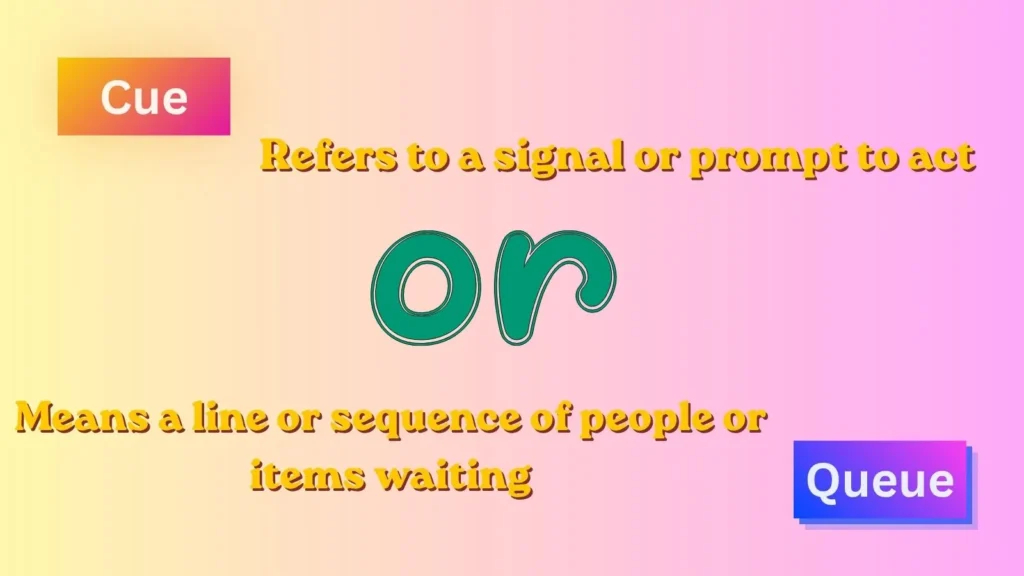
The words “cue” and “queue” sound the same but have different meanings.
- Cue refers to a signal or prompt to act.
- Queue means a line or sequence of people or items waiting.
Example:
- The actor waited for his cue.
- People stood in a long queue.
|RELATED: Fourth or Forth: What’s the Difference and When to Use Each?
Meaning of Cue or Queue
Cue
A cue is a signal, hint, or prompt. It can also refer to a stick used in games like billiards.
- Skills: Acting, timing, awareness
- Control: Indicates when to act
- Abstract: A mental or visual trigger
👉 Example:
- She took her cue from the manager and started speaking.
Queue
A queue is a line or sequence. It can be physical or digital.
- Ownership: Managed by systems or people
- Control: First come, first served
- Abstract: Order and waiting system
👉 Example:
- Your request is in the queue.
Why People Misspell Cue or Queue
Many learners confuse cue or queue due to pronunciation. English often uses double letters, which adds complexity.
👉 Examples:
- Address (double “d” and “s”)
- Success (double “c” and “s”)
Typing fast also causes errors:
- Writing “que” instead of queue
- Mixing cue with queue
👉 Tip: If it relates to waiting, think queue = line.
Origin of Cue or Queue
Both words have different origins despite sounding identical.
- Cue comes from Latin “quando” meaning “when,” later used in theatre for timing.
- Queue comes from Latin “cauda” meaning “tail,” which reflects a line of people.
👉 Over time, cue became linked to signals, while queue described order or sequence.
British vs American English
Good news! The spelling of cue or queue is the same in both dialects.
| Word | British English | American English | Meaning |
|---|---|---|---|
| Cue | Cue | Cue | Signal or prompt |
| Queue | Queue | Queue | Line or sequence |
👉 No spelling differences—only usage context matters.
When to Use Cue or Queue
Use cue or queue depending on context:
- Essays: Use cue for signals, queue for sequences
- Emails: “Please wait in the queue”
- Work reports: “System processed tasks in a queue”
- Legal documents: Rare but precise usage
- Casual writing: Common in daily communication
👉 Example:
- He missed his cue during the presentation.
- The system placed users in a queue.
Common Mistakes
People often misuse cue or queue in writing.
Frequent Errors:
- Writing “que” instead of queue
- Using cue when referring to a line
- Typing quickly and skipping letters
Correct vs Incorrect:
- ❌ I stood in a cue
- ✅ I stood in a queue
- ❌ Wait for your queue to speak
- ✅ Wait for your cue to speak
Everyday Examples
Here’s how cue or queue appear in daily life:
- Emails: “Your request is in the queue.”
- Social media: “Waiting in a long queue for tickets!”
- Professional writing: “The speaker missed his cue.”
- School assignments: “Use context clues as a cue.”
👉 Both words are common in real-world communication.
Usage Comparison Table
| Context | Correct Sentence | Incorrect Sentence |
|---|---|---|
| Objects | He picked up the cue stick | He picked up the queue stick |
| Skills | She followed the cue perfectly | She followed the queue |
| Legal/Process | Files are processed in a queue | Files are processed in a cue |
| Daily Speech | Join the queue | Join the cue |
FAQs About Cue or Queue
1. What is the difference between cue or queue?
Cue is a signal; queue is a line or sequence.
2. How do I remember the spelling?
Think: queue = line (many letters like many people).
3. Is “que” correct?
No, “que” is incorrect in English for both meanings.
4. Can cue and queue be used interchangeably?
No, they have completely different meanings.
5. Why is queue spelled with so many letters?
It comes from French and Latin roots, preserving its original form.
6. Which word is more common?
Both are common but used in different contexts.
7. Is the pronunciation the same?
Yes, both are pronounced as “kyoo.”
Conclusion
Understanding cue or queue becomes easy once you link meaning with context.
- Cue = signal or prompt
- Queue = line or order
Avoid mistakes by remembering usage and practicing examples. Pay attention to spelling, especially in formal writing. With time, choosing between cue or queue will feel natural and effortless.