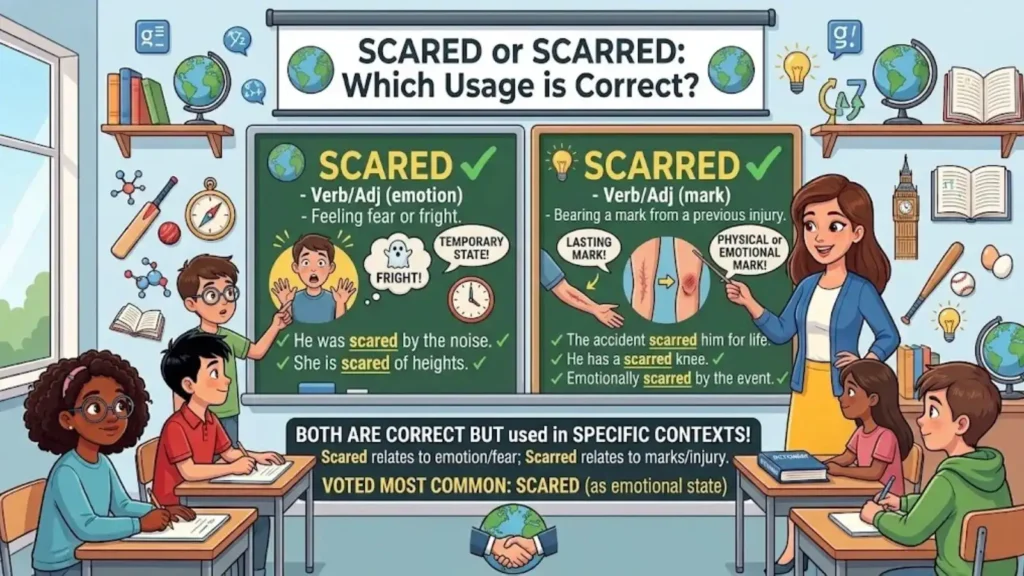
Scared means feeling afraid, while scarred means having a mark or lasting damage from an injury or painful experience.
Imagine a child who sees a large dog running toward him. He feels afraid and runs away. He is scared. Now imagine another child who falls off a bike and gets a mark on his knee. He is scarred. Both words sound similar, but they have different meanings.
Many people search for scared or scarred because the words look and sound alike. However, you cannot use them in the same way. One describes fear, while the other describes a mark or a lasting effect. These words can also describe feelings after a hard time in life.
Learning the difference between scared or scarred can help you write clear emails, schoolwork, social media posts, and stories. It can also help you understand books, movies, and everyday talks. Once you learn their meanings, choosing the right word becomes easy.
RELATED: Sapphire or Saphire – Which Spelling Is Correct and Why It Matters
Pronunciation of Scared and Scarred
| Word | US Pronunciation | UK Pronunciation |
|---|---|---|
| Scared | /skerd/ | /skeəd/ |
| Scarred | /skɑːrd/ | /skɑːd/ |
Tip:
In many American accents, scared and scarred sound different because their vowel sounds differ. In some accents, especially in parts of the UK, they may sound very similar. Context helps you understand the meaning.
Difference Between Scared and Scarred
Here are 10 clear differences between the two words.
1. Basic Meaning
Scared means afraid of something.
- ✅ Correct: The child is scared of the dark.
- ❌ Incorrect: The child is scarred of the dark.
Scarred means marked or damaged by an injury or painful event.
- ✅ Correct: The fall scarred his knee.
- ❌ Incorrect: The fall scared his knee.
2. Fear vs. Damage
Scared describes a feeling of fear. Scarred describes a mark or lasting harm.
- ✅ Correct: I was scared during the storm.
- ❌ Incorrect: I was scarred during the storm.
- ✅ Correct: The accident scarred his face.
- ❌ Incorrect: The accident scared his face.
3. Use With People
Scared often describes how a person feels.
- ✅ Correct: She is scared of snakes.
- ❌ Incorrect: She is scarred of snakes.
Scarred can describe a person’s body or emotional state.
- ✅ Correct: He felt scarred by years of bullying.
- ❌ Incorrect: He felt scared by years of bullying.
4. Use With Animals
Scared can describe an animal that feels fear.
- ✅ Correct: The loud noise scared the cat.
- ❌ Incorrect: The loud noise scarred the cat.
Scarred can describe an animal with a lasting mark.
- ✅ Correct: The dog has a scarred ear.
- ❌ Incorrect: The dog has a scared ear.
5. Physical Meaning
Scared does not usually describe a physical mark.
- ✅ Correct: The loud bang scared me.
- ❌ Incorrect: The loud bang scarred me.
Scarred often describes a lasting physical mark.
- ✅ Correct: His arm was scarred after the burn.
- ❌ Incorrect: His arm was scared after the burn.
6. Emotional Meaning
Scared describes fear in the moment or over time.
- ✅ Correct: I am scared to speak in public.
- ❌ Incorrect: I am scarred to speak in public.
Scarred can describe deep emotional pain that remains.
- ✅ Correct: The loss left her emotionally scarred.
- ❌ Incorrect: The loss left her emotionally scared.
7. Grammar and Word Forms
Scared is often used as an adjective or as the past form of scare.
- ✅ Correct: The movie scared me.
- ❌ Incorrect: The movie scarred me.
Scarred is the past form of scar and can also work as an adjective.
- ✅ Correct: The fire scarred the wall.
- ❌ Incorrect: The fire scared the wall.
8. Common Word Patterns
Scared often appears with of, by, or to.
- ✅ Correct: He is scared of heights.
- ❌ Incorrect: He is scarred of heights.
Scarred often appears with by, from, or with.
- ✅ Correct: Her skin was scarred by the burn.
- ❌ Incorrect: Her skin was scared by the burn.
9. Figurative Use
Scared can describe fear about an event or choice.
- ✅ Correct: I am scared about my exam.
- ❌ Incorrect: I am scarred about my exam.
Scarred can describe lasting emotional pain.
- ✅ Correct: His past left him scarred.
- ❌ Incorrect: His past left him scared.
10. Everyday Context
Use scared when someone feels afraid.
- ✅ Correct: The little girl was scared by the thunder.
- ❌ Incorrect: The little girl was scarred by the thunder.
Use scarred when someone or something has a lasting mark or effect.
- ✅ Correct: The old tree was scarred by lightning.
- ❌ Incorrect: The old tree was scared by lightning.
Nature and Behaviour of Scared and Scarred
Scared
Scared describes fear. It can be a short feeling or a fear that lasts for a long time. People may feel scared of dogs, storms, tests, or new places. A person can also feel scared about the future.
Examples:
- ✅ I am scared of spiders.
- ✅ She was scared when the lights went out.
- ❌ He is scarred of flying.
Scarred
Scarred describes a mark or lasting damage. It can refer to skin, buildings, land, or emotional pain. A scar may remain after the original injury has healed.
Examples:
- ✅ The crash scarred the car door.
- ✅ He was emotionally scarred by the loss.
- ❌ The child was scarred of the dark.
Why People Get Confused About Scared and Scarred
People confuse these words for three main reasons.
First, both words begin with scar- and end with -ed. Their spelling looks very similar.
Second, their pronunciation can be close, especially in some British accents. This makes them harder to tell apart when people speak.
Third, both words can describe an experience involving danger or pain. A frightening event may scare someone, while a harmful event may leave someone scarred.
Remember this simple rule:
- ✅ Scared = afraid
- ✅ Scarred = marked or deeply hurt
Comparison Table
| Feature | Scared | Scarred |
|---|---|---|
| Main meaning | Feeling afraid | Having a mark or lasting harm |
| Common use | Fear and worry | Physical or emotional damage |
| Word type | Adjective; past form of scare | Adjective; past form of scar |
| Physical example | The noise scared me. | The burn scarred his hand. |
| Emotional example | She is scared of failure. | Failure left him emotionally scarred. |
| Common pattern | Scared of heights | Scarred by an accident |
| Opposite idea | Feeling safe or brave | Being unmarked or healed |
| Correct question | What are you scared of? | What left you scarred? |
Similarity: Both words can describe how a person responds to a difficult event. However, scared focuses on fear, while scarred focuses on a mark or lasting effect.
The Origin of Scared and Scarred
Origin of Scared
The word scared comes from the verb scare, which means to frighten someone. The verb has roots in older forms of English and related Germanic words. Over time, scared became a common way to describe a person who feels fear.
Example:
- ✅ The sudden noise scared the baby.
Origin of Scarred
The word scarred comes from the noun and verb scar. A scar is a mark left after an injury heals. The word has a long history in English and is linked to older European word forms for a mark or wound.
Today, scarred can describe both physical marks and deep emotional harm.
Examples:
- ✅ The cut scarred his hand.
- ✅ The painful memory left her scarred.
British vs American English
The meanings and spellings of scared and scarred are the same in British and American English. Neither word needs a different spelling for either variety.
| Context | American English | British English |
|---|---|---|
| Fear | I am scared of dogs. | I am scared of dogs. |
| Physical mark | His face is scarred. | His face is scarred. |
| Emotional harm | She felt scarred by the event. | She felt scarred by the event. |
| Spelling | Scared / scarred | Scared / scarred |
The main difference may be pronunciation. Many American speakers pronounce the vowel in scared differently from the vowel in scarred. In some British accents, the words can sound more alike.
Which One Should You Use?
Choose the word based on what you want to say.
- ✅ Use scared when you mean afraid.
- ✅ Use scarred when you mean marked or deeply hurt.
- ❌ Do not use scarred just because someone feels fear.
- ❌ Do not use scared when you mean a physical scar.
For American, British, and global English, the same meaning rule applies.
Examples:
- ✅ I am scared of the storm.
- ✅ The storm scarred the old house.
- ✅ He was scared after the accident.
- ✅ The accident left him scarred.
When writing for a global audience, choose clear sentences that make the meaning easy to understand.
Common Mistakes
| Incorrect or Confusing Sentence | Better Sentence | Why? |
|---|---|---|
| ❌ I am scarred of dogs. | ✅ I am scared of dogs. | Scared means afraid. |
| ❌ The cut scared my hand. | ✅ The cut scarred my hand. | Scarred means left a mark. |
| ❌ She is scared by an old scar. | ✅ She is scared by the sight of the old scar. | The scar itself may cause fear. |
| ❌ He was scarred of the exam. | ✅ He was scared of the exam. | Use scared of for fear. |
| ❌ The burn scared his arm. | ✅ The burn scarred his arm. | The burn left a mark. |
| ❌ The memory made him scarred. | ✅ The memory left him emotionally scarred. | This better expresses lasting harm. |
Important: A sentence is not always wrong just because it uses the less common word. For example, The film scared me means the film made me afraid, while The film scarred me means it had a lasting harmful effect on me.
Everyday Usage Examples
In Emails
- ✅ I am scared that I may miss the deadline.
- ✅ The accident left a scarred area on the wall.
On Social Media
- ✅ I was so scared when the lights went out!
- ✅ Life has scarred me, but I am still moving forward.
In News Reports
- ✅ Residents were scared by the loud explosion.
- ✅ The fire scarred several buildings.
In Formal Writing
- ✅ The witness was scared during the incident.
- ✅ The report described a landscape scarred by years of mining.
These examples show why choosing the right word matters. One expresses fear, while the other expresses a mark or lasting damage.
Usage Trends
Both words are common in modern English, but people use them in different ways.
Scared often appears in daily conversations, stories, schoolwork, and posts about fear. People use it when talking about danger, worry, or an uncertain event.
Scarred often appears in reports, personal stories, medical descriptions, and writing about difficult experiences. It can describe physical marks or emotional harm.
The phrase emotionally scarred is also common when people talk about lasting effects after a painful event.
Search trends can change over time and across regions. However, the core difference between the words remains the same.
Metaphors and Similes
Writers use both words to make descriptions more powerful.
Scared
A metaphor compares fear to another thing without using like or as.
- Metaphor: Fear was a shadow over his mind.
- Simile: She was as scared as a rabbit in a storm.
Scarred
A metaphor can show how pain leaves a lasting effect.
- Metaphor: His past was a scar on his heart.
- Simile: The land looked like a face scarred by fire.
These expressions help readers imagine fear and lasting pain. They are useful in stories, poems, and personal writing.
Connotative Meaning
A word’s connotation is the feeling or idea it suggests beyond its basic meaning.
Scared
Scared often has a negative meaning because it suggests fear. However, it can also show a normal response to danger.
- Negative: He was too scared to speak.
- Neutral: The child was scared during the storm.
- Positive outcome: She felt scared but still tried something new.
Scarred
Scarred often suggests pain or damage. It can also suggest survival and strength.
- Negative: The accident left him scarred.
- Neutral: The old table was scarred by years of use.
- Positive message: She was scarred by hardship but learned to keep going.
Neither word is always good or bad. The full sentence shapes its meaning.
Idioms and Proverbs
There are no widely established English idioms that depend on the exact contrast between scared and scarred. However, several common expressions relate to their meanings.
Expressions About Fear
- Scared stiff: Very frightened.
Example: I was scared stiff when I heard the crash. - Afraid of your own shadow: Easily frightened.
Example: After the break-in, he seemed afraid of his own shadow. - Face your fears: Deal with what frightens you.
Example: She decided to face her fears and speak in public.
Expressions About Lasting Harm
- Wounds that time cannot heal: Pain that remains for a long time.
Example: The loss left wounds that time could not heal. - Wear your heart on your sleeve: Show your feelings openly.
Example: He wears his heart on his sleeve, even after hard times.
These expressions are related to fear or emotional pain, but they do not make scared and scarred interchangeable.
Literature and Movies
Writers and filmmakers often explore fear, wounds, and the effects of painful events. Both words fit these themes.
Literature
Frankenstein (1818), by Mary Shelley
This Gothic novel explores fear, rejection, and emotional pain. Its characters experience frightening events and lasting harm. The story provides useful examples of the ideas behind scared and scarred.
Jane Eyre (1847), by Charlotte Brontë
This novel explores emotional suffering, fear, and personal growth. It shows how painful experiences can affect a person’s feelings and choices.
Movies
Jaws (1975, United States)
This thriller creates fear through the threat of a shark. The characters’ reactions help illustrate the meaning of scared.
The Elephant Man (1980, United Kingdom and United States)
This historical drama explores the life of Joseph Merrick and the way society treats physical difference. It can support discussion of visible marks, human dignity, and emotional pain, although scarred is not a complete description of Merrick’s condition.
These works show how fear and lasting harm can shape a story. They also remind readers to use descriptive words with care.
Usefulness in Daily Life
You can use these words in many everyday situations.
- At school: Write, “I was scared before the test.”
- At home: Say, “The hot pan scarred the table.”
- At work: Write, “The team was scared about missing the deadline.”
- In a personal story: Say, “The event left me emotionally scarred.”
- In a news report: Write, “The fire scarred the old building.”
The key is to ask yourself one question: Am I talking about fear, or am I talking about a lasting mark or effect?
If you mean fear, choose scared. If you mean a lasting mark or harm, choose scarred.
FAQs
1. What is the main difference between scared and scarred?
Scared means afraid. Scarred means marked by an injury or affected by lasting harm.
2. Is it scared of or scarred of?
Use scared of when you mean afraid of something.
- ✅ She is scared of spiders.
- ❌ She is scarred of spiders.
3. Can someone be emotionally scarred?
Yes. Emotionally scarred describes lasting emotional pain after a difficult experience.
Example: The loss left him emotionally scarred.
4. Can scared and scarred sound the same?
They sound different in many accents, but they can sound very similar in some British accents. The sentence often helps you understand the intended meaning.
5. Is scarred always about a physical injury?
No. It can describe physical marks or lasting emotional harm.
Example: Years of bullying left her scarred.
6. What is the past tense of scare?
The past tense of scare is scared.
Example: The sudden noise scared me.
7. What is the past tense of scar?
The past tense of scar is scarred.
Example: The fire scarred the wooden door.
Conclusion
The difference between scared or scarred is simple once you learn what each word means. Scared describes fear. You can use it when someone feels afraid of a sound, place, person, or event. Scarred describes a physical mark or lasting harm. It can refer to damaged skin, a marked building, or emotional pain that remains after a hard experience.
Both words are useful in everyday speech, schoolwork, emails, stories, and formal writing. However, they are not interchangeable. If you use the wrong word, your sentence may give readers a different idea than you intended.
Remember these two simple rules: scared = afraid and scarred = marked or deeply hurt. Use them to check your writing before you publish it or send it to someone.
With practice, you will find it easier to choose the correct word. You will also write more clearly and help your readers understand your meaning without confusion.