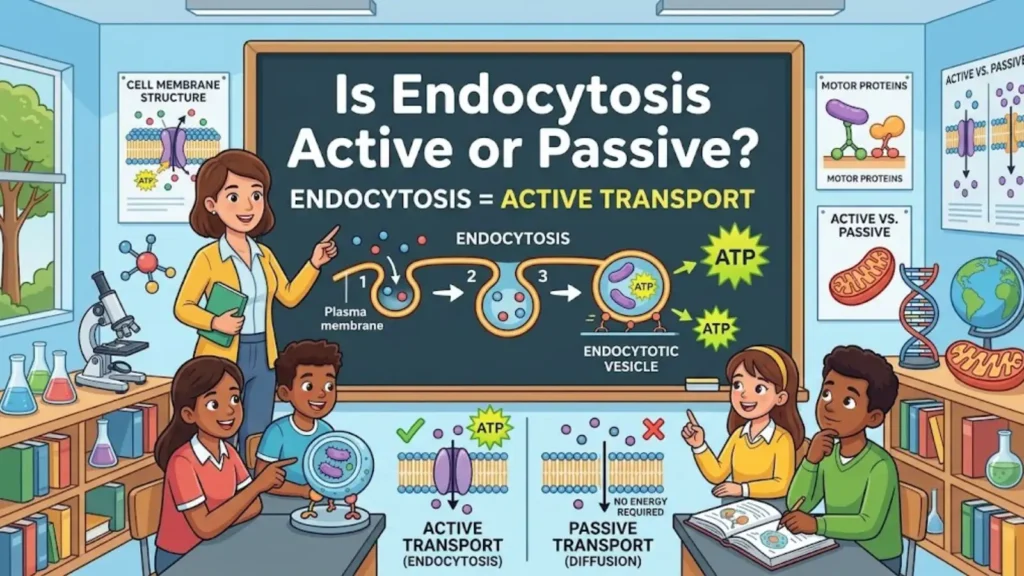
Endocytosis is an important cellular transport process that often appears in biology exams and assignments. Students commonly ask, “Is endocytosis active or passive?” The answer is straightforward: endocytosis is an active transport process because the cell requires energy to bring materials inside. The cell membrane surrounds the material, folds inward, and pinches off to form a vesicle. This process allows cells to take in large particles, fluids, macromolecules, and specific substances that cannot simply cross the membrane.
Quick Answer – Is Endocytosis Active or Passive?
Endocytosis is active transport, not passive transport. It requires cellular energy to reshape the plasma membrane and enclose material. During endocytosis, the membrane moves inward around material outside the cell and forms an internal vesicle. The three major forms are phagocytosis, pinocytosis, and receptor-mediated endocytosis. Unlike diffusion or osmosis, endocytosis does not simply allow particles to cross the membrane on their own.
Meaning of Endocytosis
Endocytosis means the process by which a cell takes material into itself by using its plasma membrane. The word describes movement into the cell. Instead of allowing a large particle to pass directly through the membrane, the cell surrounds it and creates a vesicle. For example, phagocytosis allows certain cells to engulf large particles, while pinocytosis takes in extracellular fluid.
Why People Confuse “Active” and “Passive” in Endocytosis
Students sometimes confuse endocytosis with passive transport because both processes move substances across the cell boundary. The key difference is energy. Passive transport, such as diffusion, does not require cellular energy. Endocytosis involves membrane deformation and vesicle formation, making it an energy-dependent transport mechanism.
Origin of the Keyword
The scientific term endocytosis comes mainly from Greek word elements rather than Latin roots. Endo- means “within” or “inside,” while kytos means “cell” or “container.” The suffix -osis indicates a process or condition. Thus, endocytosis describes a process involving material entering a cell. This particular scientific word is built primarily from Greek roots.
British vs American English
The spelling endocytosis remains the same in both British and American English. There is no spelling difference like color/colour or center/centre. Students in different English-speaking regions can use the same scientific spelling.
| English Variety | Correct Spelling | Example |
|---|---|---|
| American English | endocytosis | Endocytosis requires energy. |
| British English | endocytosis | Endocytosis requires energy. |
| Canadian English | endocytosis | Endocytosis forms vesicles. |
| Australian English | endocytosis | Endocytosis is active transport. |
When to Use “Endocytosis”
Use endocytosis whenever you discuss cellular uptake through the plasma membrane. The term works well in school essays, biology assignments, laboratory reports, research papers, exams, and professional scientific writing. You can also use it in casual educational discussions. Pair it with related terms such as active transport, vesicle, plasma membrane, phagocytosis, and receptor-mediated uptake.
Common Mistakes
A common mistake is calling endocytosis passive transport. That classification is incorrect because endocytosis requires energy. Another mistake is confusing it with diffusion, which moves particles without cellular energy. Students may also write endocytosos or endocytoses when they mean the singular process. Remember: endo + cyto + sis = endocytosis.
Everyday Examples of Endocytosis
Endocytosis happens constantly in living cells. Immune cells can engulf particles or microorganisms through phagocytosis. Cells can also take in extracellular fluid through pinocytosis. In receptor-mediated endocytosis, specific molecules bind to receptors before the membrane brings them inside. These examples show how cells carefully control what enters their internal environment.
Usage Comparison Table
| Topic | Correct Sentence | Incorrect Sentence |
|---|---|---|
| Large particles | Endocytosis allows cells to engulf large particles. | Endocytosis lets large particles diffuse through the membrane. |
| Energy | Endocytosis requires cellular energy. | Endocytosis occurs without energy. |
| Vesicles | Endocytosis forms an internal vesicle. | Endocytosis leaves the material outside the cell. |
| Phagocytosis | Phagocytosis is a form of endocytosis. | Phagocytosis is passive diffusion. |
| Receptors | Receptor-mediated endocytosis selectively takes in certain molecules. | It randomly moves every molecule inside. |
Endocytosis vs Passive Transport
The biggest difference involves energy and mechanism. Passive transport includes processes such as simple diffusion and facilitated diffusion. These processes do not require cellular energy. Endocytosis is different because the membrane must actively change shape and create a vesicle around the material. Therefore, endocytosis belongs to active transport.
Types of Endocytosis
There are three commonly taught forms of endocytosis. Phagocytosis involves engulfing relatively large particles. Pinocytosis involves uptake of extracellular fluid and dissolved substances. Receptor-mediated endocytosis is more selective because specific molecules bind to receptors before being internalized. All three involve inward movement of the plasma membrane.
FAQs About Is Endocytosis Active or Passive?
Is endocytosis active or passive?
Endocytosis is active transport. The cell uses energy while its plasma membrane surrounds extracellular material and forms an internal vesicle.
Does endocytosis require ATP?
Yes. Endocytosis is an energy-dependent process. Cellular energy supports the membrane and molecular machinery involved in bringing material inside.
Why is endocytosis considered active transport?
It is considered active because the cell must perform work to reshape its membrane and internalize material.
Is phagocytosis active or passive?
Phagocytosis is active. It is a form of endocytosis in which a cell engulfs relatively large particles.
Is pinocytosis active or passive?
Pinocytosis is active transport. The cell takes in extracellular fluid by forming membrane-bound vesicles.
Is receptor-mediated endocytosis active?
Yes. Receptor-mediated endocytosis is an active form of cellular uptake involving specific receptors.
What is the easiest way to remember it?
Remember: “Endocytosis takes energy to take things in.” If the cell surrounds material and forms a vesicle, think active transport.
Conclusion
So, is endocytosis active or passive? The answer is clear: endocytosis is active transport. It allows cells to bring in large particles, fluids, and selected molecules by enclosing them within membrane-bound vesicles. Its major forms include phagocytosis, pinocytosis, and receptor-mediated endocytosis. For exams and assignments, remember: endocytosis = energy + membrane movement + vesicle formation.

Hi, I’m Lily Brown, the voice behind Grammar Meaning! I make grammar simple and easy for everyone. I create helpful content on basicsgrammar.com.