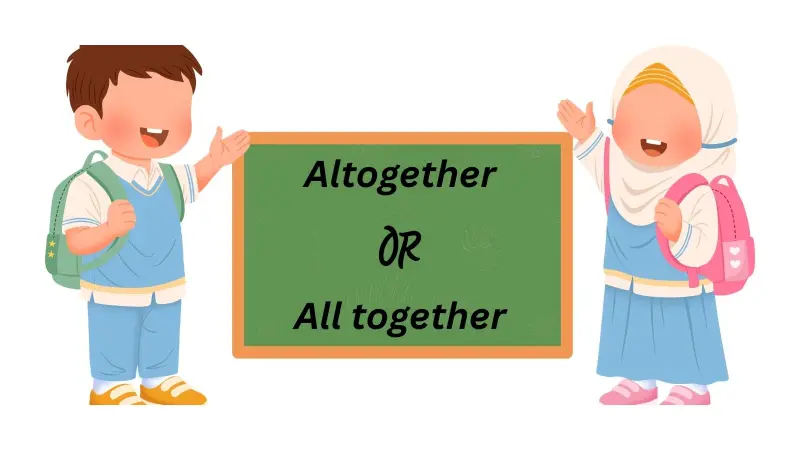
Because the terms “whole” and “all together” sound the same yet have different meanings, many authors struggle to decide between them. Emails, school assignments, business documents, and online writing all exhibit this uncertainty. Using the incorrect form might alter a sentence’s meaning and detract from the clean appearance of your work.
Fortunately, the rule is straightforward. While “all together” refers to everyone or everything in one location or at the same time, “altogether” is an adverb that indicates “completely, entirely, or in total.”
Choosing the appropriate expression is simple once you grasp the distinction. To help you write confidently, this book discusses the meanings, origins, spelling rules, typical errors, regional usage, examples, Google search trends, and useful advice.
|See also: Everyday vs every day
Altogether or All Together – Quick Answer
Both altogether and all together are correct, but they have different meanings.
- Altogether = completely, entirely, or in total.
- All together = everyone or everything gathered in one place or acting at the same time.
Examples
- The movie was altogether amazing.
- We stood all together for the group photo.
The Origin of Altogether or All Together
The phrase all together appeared first in Middle English, describing people or things gathered in one place.
Later, frequent usage caused the words to merge into altogether, creating a single adverb meaning “completely” or “entirely.”
Today, both forms remain correct because they serve different grammatical purposes rather than representing spelling mistakes.
British English vs American English Spelling
Unlike color/colour or favorite/favourite, there is no spelling difference between British and American English.
| American English | British English | Meaning |
|---|---|---|
| altogether | altogether | Completely or entirely |
| all together | all together | Everyone together |
Both English varieties follow the same grammar rules.
Which Spelling Should You Use?
Choose the expression based on meaning—not your audience.
Use altogether when you mean:
- Completely
- Entirely
- On the whole
- In total
Use all together when referring to:
- A group gathered
- Everyone acting at once
- Things collected in one place
This rule works in the US, UK, Canada, Australia, and other English-speaking countries.
Common Mistakes with Altogether or All Together
Incorrect
- We were altogether in one room.
- They finished the project all together impressive.
Correct
- We were all together in one room.
- The project was altogether impressive.
A simple test helps:
If you can replace the phrase with completely, use altogether.
If you mean everyone together, use all together.
Altogether or All Together in Everyday Examples
“We are all together for today’s meeting.”
Social Media
“The concert was altogether unforgettable!”
News
“The rescue team worked all together to save the hikers.”
Formal Writing
“The proposal is altogether practical and well researched.”
Altogether or All Together – Google Trends & Usage Data
Search data shows that many users search altogether or all together because both forms sound identical. Students, professionals, and English learners frequently look for grammar explanations to avoid mistakes in academic and business writing.
Interest remains consistent worldwide because the distinction is based on grammar rather than regional spelling.
|SEE LEARN MORE: Where or were
Comparison Table
| Feature | Altogether | All Together |
|---|---|---|
| Part of speech | Adverb | Phrase |
| Meaning | Completely, entirely | Everyone in one place |
| Number of words | One | Two |
| Example | It was altogether different. | We sang all together. |
People also ask
Q: When should I use altogether?
A: Use altogether when you mean completely, entirely, or in total.
Q: How do you use altogether in a sentence?
A: Example: The experience was altogether unforgettable.
Q: Is altogether correct spelling?
A: Yes. Altogether is the correct one-word spelling when used as an adverb.
Q: Is “altogether” used in British English?
A: Yes. Altogether is correct and commonly used in both British and American English.
Conclusion
Once you know what they represent, it becomes easier to choose between altogether and all together. When referring to anything as fully, wholly, or in total, use altogether. When referring to individuals or objects gathering in one location or acting concurrently, use all together.
The rule is easy to implement globally because it is the same in both American and British English. You can consistently generate writing that is clear, professional, and self-assured by carefully rereading and comprehending the sentence context.

Hi, I’m Lily Brown, the voice behind Grammar Meaning! I make grammar simple and easy for everyone. I create helpful content on basicsgrammar.com.