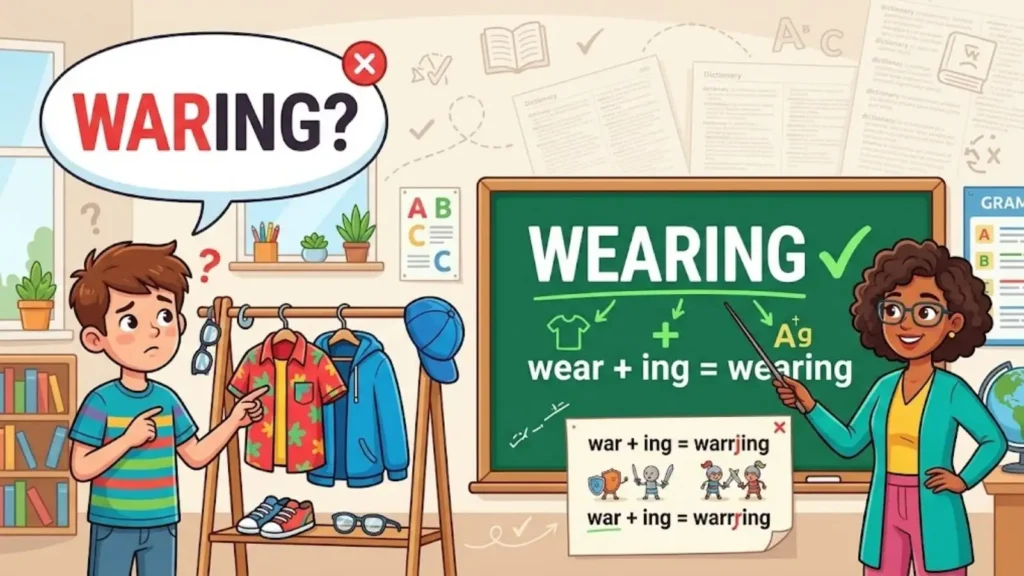
If you are talking about clothes, shoes, glasses, or accessories, wearing is the correct word. Waring is a real but very uncommon English word, so it can confuse writers and spell-checkers.
Imagine texting a friend before dinner: “What are you waring tonight?” That sentence looks almost right, but it contains a spelling mistake for the meaning you want. The correct version is, “What are you wearing tonight?”
The confusion happens because waring and wearing sound alike in English. They are also separated by only one letter. However, they do not normally serve the same purpose. Wearing comes from the verb wear, while waring is an uncommon form connected with the verb ware.
So, which spelling should you choose? In ordinary writing, the answer is simple: use wearing when you mean having something on your body.
Table of Contents
- Quick Answer
- What Does Wearing Mean?
- What Does Waring Mean?
- Waring vs Wearing: Key Difference
- Origin and Word History
- British English vs American English
- Which One Should You Use?
- Common Spelling Mistakes
- Everyday Examples
- Usage and Popularity
- Comparison Table
- Special Uses of Wearing
- Frequently Asked Questions
- Conclusion
Waring vs Wearing: Quick Answer
Wearing is the standard and overwhelmingly common word when you mean having clothes, shoes, glasses, jewelry, or another item on your body.
Waring exists as a rare form of the verb ware, but it is not the normal spelling of wearing. Merriam-Webster lists waring under ware, while wearing is the present participle of wear.
Easy rule to remember
- Wear → wearing = clothes or items on your body
- Ware → waring = rare and unusual usage
- War → warring = fighting or being in conflict
For example:
She is wearing a blue jacket. ✅
She is waring a blue jacket. ❌
The two groups are warring over the territory. ✅
This simple three-word pattern can prevent most mistakes.
What Does Wearing Mean?
Wearing is the present participle of the verb wear. We use it when someone has clothing, accessories, equipment, or another item on their body.
Merriam-Webster defines wear as having something on the person or using something as clothing, adornment, or assistance.
Examples of wearing
- She is wearing a red dress.
- He is wearing black shoes.
- I am wearing my new glasses.
- They were wearing school uniforms.
- She is wearing a silver necklace.
- Are you wearing a seat belt?
The word can also describe something that causes tiredness or gradually causes wear. For instance, a difficult journey can be described as wearing.
Correct and incorrect examples
| Incorrect | Correct |
|---|---|
| He is waring a suit. | He is wearing a suit. |
| She was waring earrings. | She was wearing earrings. |
| What are you waring today? | What are you wearing today? |
| They are waring uniforms. | They are wearing uniforms. |
The extra e matters.
What Does Waring Mean?
Waring is a legitimate but extremely uncommon English form. It is the present participle or gerund of ware, rather than the verb wear.
This distinction matters because ware has meanings that are quite different from wear. Modern readers rarely encounter waring in ordinary conversation or everyday writing.
Therefore, if you are writing about clothes, accessories, uniforms, or appearance, waring is not the word you want.
Example
She is waring a dress. ❌
The writer almost certainly means:
She is wearing a dress. ✅
Because waring is a rare word, most learners should simply remember wearing for everyday English.
Waring vs Wearing: The Key Difference
The biggest difference comes from their base verbs.
Wearing
Wearing = wear + -ing
It describes having something on your body or, in some contexts, something that causes fatigue or shows the effects of use.
Examples:
- He is wearing a hat.
- She is wearing makeup.
- The old shoes are wearing thin.
- The long trip was wearing.
Waring
Waring = ware + -ing
It belongs to the uncommon verb ware. This form does not normally mean putting clothes on your body.
That is why replacing wearing with waring creates an error in everyday sentences.
Origin and Word History
The words have different histories even though they look and sound remarkably similar.
The verb wear is very old. Merriam-Webster traces it to Middle English weren and Old English werian, with the basic sense connected to clothing. Its first known use as a verb dates to before the 12th century.
The modern word wearing developed naturally from this verb.
The word ware, meanwhile, has several historical senses. Merriam-Webster traces the noun ware to Middle English and Old English waru, while the adjective ware has a separate Germanic history associated with being watchful or cautious.
This explains why waring can technically appear in dictionaries without being the normal spelling of wearing.
British English vs American English
There is no American-versus-British spelling difference between wearing and waring.
Both American English and British English use:
wear → wearing
For example:
- American English: “She is wearing a sweater.”
- British English: “She is wearing a jumper.”
The clothing vocabulary may sometimes differ, but the spelling of wearing does not.
So, if you are writing for a British, American, Canadian, Australian, or international audience, wearing remains the safe standard.
Which One Should You Use?
Use wearing whenever your sentence involves clothing or something carried or displayed on the body.
Choose wearing for:
- Shirts
- Dresses
- Jackets
- Shoes
- Hats
- Glasses
- Watches
- Jewelry
- Uniforms
- Protective equipment
- Makeup
- Accessories
A simple test
Ask yourself:
“Does the sentence mean someone has something on their body?”
If the answer is yes, choose wearing.
Example:
Maria is wearing a green coat.
Yes, Maria has the coat on her body.
The workers are wearing safety helmets.
Yes, the helmets are on their heads.
This test works in most everyday situations.
Common Mistakes
Because waring looks like a shortened version of wearing, writers sometimes leave out the e.
Mistake 1: Leaving out “e”
❌ I am waring my favorite shirt.
✅ I am wearing my favorite shirt.
Mistake 2: Confusing it with “warring”
Some people also confuse waring with warring.
These words have completely different meanings.
❌ The countries are waring against each other.
✅ The countries are warring against each other.
Warring comes from war and means fighting or being involved in conflict.
Mistake 3: Trusting pronunciation
Waring and wearing can sound alike. Wiktionary lists them as homophones in English.
That means listening alone may not help.
You need to remember the spelling based on meaning.
Everyday Examples
You will see wearing in many ordinary situations.
In emails
Please remember that all visitors must be wearing their identification badges.
On social media
What are you wearing for the concert tonight?
In the news
The athletes were wearing protective equipment during the event.
In the classroom
The students were wearing their school uniforms.
daily conversation
I am wearing my new sneakers today.
In shopping
She was wearing a beautiful black jacket.
In all these examples, wearing describes something placed on or carried by a person.
Usage Trends and Popularity
There is a huge difference in everyday usage between the two spellings.
Wearing is an ordinary, highly familiar English word. Dictionaries provide numerous meanings and examples for it, including clothing, appearance, deterioration, and fatigue.
Waring, by comparison, is rare. It may appear because of the uncommon verb ware, or as a proper name such as the surname Waring.
For practical writing, therefore, wearing is the overwhelmingly better choice when discussing clothes or appearance.
Waring vs Wearing Comparison Table
| Feature | Waring | Wearing |
|---|---|---|
| Base word | ware | wear |
| Common in modern English? | Very rare | Very common |
| Refers to clothing? | No | Yes |
| Used for accessories? | No | Yes |
| Present participle of wear? | No | Yes |
| Correct in “She is ___ a dress”? | ❌ | ✅ |
| British spelling | Rare form | Wearing |
| American spelling | Rare form | Wearing |
| Common spelling mistake? | Yes | No |
Special Uses of Wearing
Although people most often associate wearing with clothes, the word has other meanings too.
Wearing can describe fatigue
A difficult or exhausting situation can be wearing.
The constant noise was wearing on everyone.
Here, wearing does not describe clothing. It means tiring or exhausting.
Merriam-Webster also defines the adjective wearing as something that causes fatigue.
Wearing can describe physical deterioration
The verb wear can also describe gradual damage from use.
The soles of my shoes are wearing thin.
The paint is wearing away.
This meaning comes from the idea of something becoming damaged through repeated use.
Wearing apparel
You may also encounter the expression wearing apparel, although clothing or apparel usually sounds more natural today.
The phrase refers to clothing intended to be worn.
Frequently Asked Questions
Is “waring” the correct spelling of “wearing”?
No. When you mean having clothes, shoes, glasses, or accessories on your body, wearing is the correct spelling.
Is “waring” a real English word?
Yes. Waring can occur as the present participle of the uncommon verb ware. However, it is not the normal spelling of wearing.
Why do people spell wearing as “waring”?
The two words sound alike, and waring looks like a shortened version of wearing. Since English pronunciation does not always reveal spelling, learners can easily omit the ea.
Is “waring” related to war?
Not in the usual modern sense. If you mean people fighting or being involved in conflict, the correct word is warring.
What is the correct sentence: “She is waring a dress” or “She is wearing a dress”?
The correct sentence is:
She is wearing a dress.
The verb wear forms its present participle as wearing.
Is wearing spelled differently in British English?
No. Both British and American English spell the word wearing.
What is an easy way to remember the spelling?
Remember this simple pair:
wear → wearing
Think of wearing clothes. The ea stays in the word.
Conclusion
The difference between waring vs wearing becomes easy once you identify the base verb.
Wearing is the standard word for having clothes, shoes, glasses, jewelry, uniforms, or other items on your body. It comes from the verb wear and works naturally in both American and British English.
Waring is not normally a spelling mistake-free alternative to wearing. It is a rare form connected with the verb ware, so everyday writers almost never need it.
If you mean clothing, remember:
wear + ing = wearing
And if you mean conflict, remember:
war + ing = warring
When in doubt, look at the meaning rather than the sound. If someone has a shirt, coat, watch, or pair of glasses on, wearing is the word you need.