Have you ever typed judgement or judgment and stopped to wonder which one looks right? You are not alone. Both spellings appear in books, websites, newspapers, schools, and professional writing. That makes this small spelling difference confusing, especially for English learners and writers who work with both British and American English.
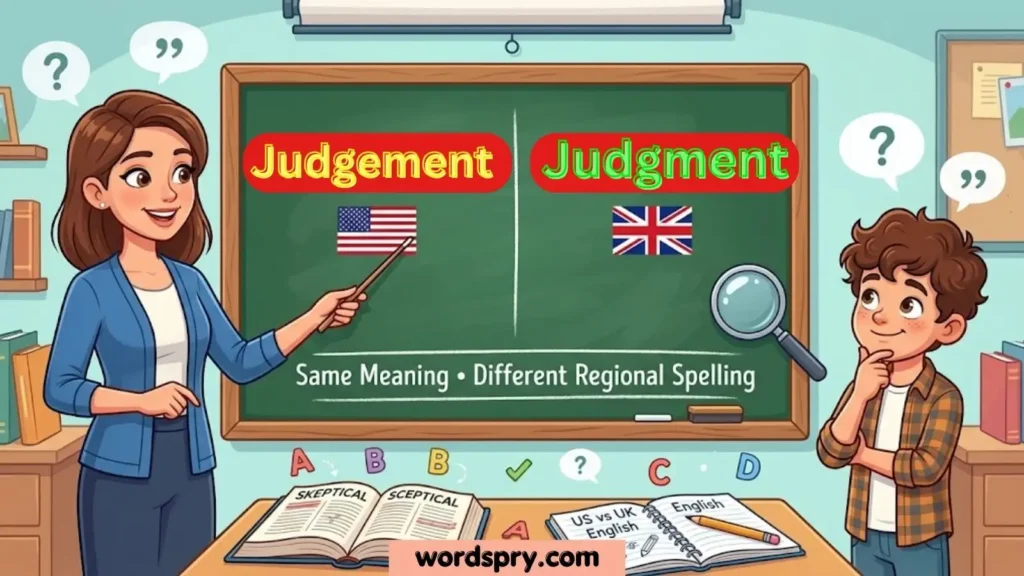
The good news is simple: both “judgement” and “judgment” are correct spellings. The main difference comes from regional English. Judgment is the standard spelling in American English. Judgement is common in British English and is also used in several other varieties of English.
This difference can matter when you write an email, article, school assignment, legal document, or social media post. Using the spelling that matches your audience helps your writing look polished and natural.
In this guide, we will explain judgement vs judgment, their meanings, origins, spelling rules, common mistakes, and everyday examples. You will also learn which form to choose for American, British, and international audiences.
Judgement or Judgment – Quick Answer
Judgment and judgement have the same meaning. Both refer to the ability to make a decision, an opinion formed after thinking, or an official decision by a court.
The main difference is regional spelling:
- Judgment → preferred in American English
- Judgement → common in British English
- Judgment → also accepted in British English, especially in legal contexts
Examples
American English:
She showed good judgment during the crisis.
British English:
She showed good judgement during the crisis.
Both sentences are correct.
However, you should keep your spelling consistent. If you use British English throughout an article, judgement may fit better. If your website targets readers in the United States, judgment is usually the better choice.
Quick Comparison
| Spelling | Correct? | Main Usage |
|---|---|---|
| Judgment | Yes | American English |
| Judgement | Yes | British English |
| Judgment | Yes | British legal writing and some general uses |
| Judgemant | No | Incorrect |
| Judgmant | No | Incorrect |
The Origin of Judgement or Judgment
The words judgment and judgement come from the same root.
The word traces back to Old French and Latin. It developed from words related to judging, deciding, and forming an opinion. English later adopted the word through French influence.
The spelling changed over time as English developed.
The ending -ment became common in English words formed from verbs. This gave rise to the spelling judgment.
The spelling judgement developed with an extra e. This pattern can also appear in other English words.
Example:
- acknowledge
- abridgement
- acknowledgement
- judgement
Over time, different English-speaking regions developed different spelling preferences.
American English often removed the extra e from judgment. British English continued to use judgement in many general contexts.
There is one important detail: judgment is not wrong in British English. In fact, it is widely used in British legal writing.
So, the difference is not about meaning. It is mainly about regional spelling and style.
British English vs American English Spelling
The clearest difference appears when comparing British and American writing.
American English normally prefers judgment.
British English commonly uses judgement, although judgment is also accepted.
Comparison Table
| Feature | American English | British English |
|---|---|---|
| Common spelling | Judgment | Judgement |
| Meaning | Decision or opinion | Decision or opinion |
| Legal use | Judgment | Judgment |
| General writing | Judgment | Judgement |
| Extra “e” | Usually removed | Often retained |
| Example | Good judgment | Good judgement |
American English Examples
His judgment was correct.
The judge gave his judgment in the case.
You need good judgment to make this decision.
British English Examples
Her judgement was based on experience.
We should not make a judgement too quickly.
His judgement proved to be correct.
The key point is consistency. Neither spelling changes the meaning.
A Note About Legal Writing
Legal English can make this issue more confusing.
In many legal contexts, judgment is preferred even in British English. For example:
The court delivered its judgment.
Therefore, if you are writing about courts or legal decisions, judgment may be the safest choice, even when using British English.
Which Spelling Should You Use?
Your choice should depend on your audience.
If You Write for Americans
Use judgment.
For example:
Good judgment is important in business.
This spelling is the standard choice in American English.
If You Write for British Readers
Use judgement in general writing.
For example:
Good judgement is important in business.
However, remember that judgment is also used in British legal writing.
If You Write for Commonwealth Audiences
Countries such as Canada, Australia, and New Zealand may follow British spelling patterns, but usage can vary.
If your website targets one specific country, check that country’s preferred style.
If You Write for a Global Audience
Either spelling can work. The best approach is to choose one English variety and use it consistently.
Example, if your website uses British spelling such as:
- colour
- organise
- travelling
- judgement
then continue using judgement.
If your website uses American spelling such as:
- color
- organize
- traveling
- judgment
then use judgment.
Consistency creates a professional impression.
Common Mistakes with Judgement or Judgment
Writers often make mistakes because they assume one spelling must be wrong.
Mistake 1: Thinking “Judgement” Is Always Wrong
This is incorrect.
Judgement is a valid spelling, especially in British English.
❌ She used poor judgement.
✅ She used poor judgement.
Mistake 2: Thinking “Judgment” Is Only American
This is also incorrect.
Judgment is used in American English and is also common in British legal contexts.
The court issued its judgment.
Mistake 3: Mixing English Varieties
Using different spelling systems in one article can make your writing look inconsistent.
For example:
The colour of the car affected his judgment.
This combines British colour with American judgment.
It is not necessarily grammatically wrong, but a consistent style is usually better.
Mistake 4: Using “Judgement” in an American Style Guide
If your audience is mainly American, judgment is usually the better choice.
Mistake 5: Confusing Judgment With Judging
These words are related but have different grammatical roles.
- Judgment → noun
- Judge → noun or verb
- Judging → present participle or gerund
- Judged → past tense
Example:
She judged the situation carefully.
Her judgment was excellent.
Judgement or Judgment in Everyday Examples
Both forms can appear in many types of writing.
In Emails
American:
I trust your judgment on this matter.
British:
I trust your judgement on this matter.
Both sentences express the same idea.
In News Writing
A news report might say:
The court’s judgment was announced on Monday.
News organizations usually follow their own style guides, so spelling may vary.
In Social Media
People may write:
Sometimes good judgment comes from experience.
Or:
Sometimes good judgement comes from experience.
Social media is less formal, so both forms can appear.
In Formal Writing
Academic and professional writing should follow one consistent English style.
American style:
The study examines how judgment affects decision-making.
British style:
The study examines how judgement affects decision-making.
In Legal Writing
Judgment is especially common:
The court entered judgment in favor of the claimant.
Here, judgment refers to an official court decision.
Judgement or Judgment – Google Trends & Usage Data
Search interest for judgement and judgment varies by country because English spelling differs across regions.
Generally, judgment is strongly associated with the United States. Judgement is more common in Britain and other regions that follow British spelling traditions.
Search behavior also depends on context.
People may search:
- judgement or judgment
- judgment meaning
- judgement meaning
- good judgment
- good judgement
- court judgment
- court judgement
- British spelling of judgment
- American spelling of judgement
The search phrase “judgement or judgment” often comes from people who want to confirm which spelling they should use.
For SEO content, the best approach is not to force one spelling. Instead, naturally discuss both forms and explain the regional difference.
If your website targets American readers, make judgment the primary spelling.
If you target British readers, make judgement the primary spelling.
For a global grammar website, including both forms can help answer a wider range of searches.
Important: Google Trends popularity can change over time and depends on the selected country, date range, and search category. Therefore, country-specific results should be checked directly when precise current figures are needed.
Judgement vs Judgment: Side-by-Side Comparison
| Word | Meaning | Common Region | Example |
|---|---|---|---|
| Judgment | Decision or opinion | American English | He showed good judgment. |
| Judgement | Decision or opinion | British English | He showed good judgement. |
| Judgment | Court decision | US and British legal English | The court issued its judgment. |
| Judgement | General evaluation | British English | Her judgement was sound. |
The most important thing to remember is that the meaning stays the same.
How to Remember the Correct Spelling
A simple trick can help.
Think of judgment as the shorter American form.
US → judgment
Think of judgement as the form often associated with British general writing.
UK → judgement
However, do not treat this as an absolute rule because British English also uses judgment.
Another useful method is to look at the spelling style of the rest of your document.
If you write:
color, organize, center
then judgment will usually fit your style.
If you write:
colour, organise, centre
then judgement will usually fit better.
FAQs About Judgement or Judgment
1. Is “judgement” or “judgment” correct?
Both are correct. Judgment is the usual American spelling, while judgement is common in British English.
2. Is “judgement” British or American?
Judgement is mainly associated with British English and other varieties influenced by British spelling.
3. Is “judgment” American English?
Yes. Judgment is the standard spelling in American English.
4. Can British English use “judgment”?
Yes. British English uses judgment, especially in legal contexts.
5. What is the difference between judgement and judgment?
There is no difference in meaning. The difference is mainly spelling and regional usage.
6. Which spelling should I use in the United States?
Use judgment for standard American English.
7. Which spelling is best for SEO?
Neither spelling is universally better. Use the form that matches your target audience. You can also mention both forms naturally to capture searches for judgement or judgment.
Conclusion
The choice between judgement or judgment is easier once you understand regional English.
Both words are correct, and both have the same meaning. Judgment is the standard spelling in American English, while judgement is common in British English and some other varieties. However, British legal writing often uses judgment.
Therefore, the best spelling depends on your audience and writing style. If you write for American readers, choose judgment. If you write general content for British readers, judgement is a natural choice. For legal writing, judgment is often preferred.
Most importantly, stay consistent. Do not switch between American and British spelling without a reason. Consistent spelling makes your website, article, email, or academic work look more professional.
So, the next time you wonder “judgement or judgment?”, remember: both are correct—the right choice depends on the variety of English you are using.

Hi, I’m John Miles, the voice behind Grammar Meaning! I share clear and practical grammar tips. You’ll find my work on basicsgrammar.com.