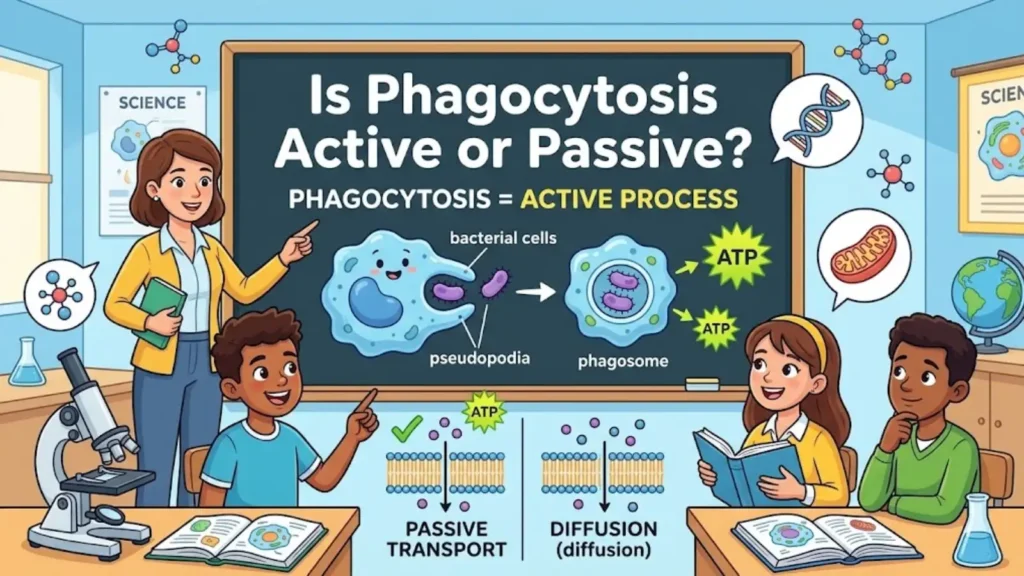
Phagocytosis is an active process, not a passive process. It requires energy, usually in the form of ATP, to help certain cells surround, engulf, and digest harmful particles, bacteria, and dead cell material.
Imagine your body is fighting a bacterial infection. Certain white blood cells act like tiny security guards. They recognize harmful invaders, surround them with their cell membrane, and pull them inside for destruction. This process is called phagocytosis.
Many biology students search for “is phagocytosis active or passive” because both active and passive transport move substances across cell membranes. However, these processes work differently. Passive transport does not require the cell to spend energy directly, while phagocytosis involves several energy-dependent steps.
RELAED: Sapphire or Saphire – Which Spelling Is Correct and Why It Matters
Table of Contents
- Quick Answer: Is Phagocytosis Active or Passive?
- What Is Phagocytosis?
- Why Is Phagocytosis an Active Process?
- How Does Phagocytosis Work?
- Active vs. Passive Transport
- Examples of Phagocytosis in Everyday Biology
- Common Mistakes About Phagocytosis
- Important Rules for Exams
- Frequently Asked Questions
- Conclusion
Quick Answer: Is Phagocytosis Active or Passive?
Phagocytosis is active transport.
Requires energy
The cell uses energy, including ATP-dependent processes, to change its shape and engulf large particles.
Protects the body
Immune cells use phagocytosis to capture bacteria, cellular waste, and other unwanted material.
Uses a cell membrane
The membrane surrounds the target and forms a small internal sac called a phagosome.
Exam tip:
If a question asks whether phagocytosis is active or passive, choose active because the process requires cellular energy.
What Is Phagocytosis?
Phagocytosis is a type of endocytosis in which a cell engulfs large particles from its surroundings. The cell membrane extends around the particle and encloses it inside a membrane-bound structure called a phagosome. Later, the phagosome can fuse with a lysosome, where enzymes help break down the captured material.
NCBI Bookshelf
The word describes the process of a cell essentially “eating” something. Specialized immune cells use this mechanism to help defend the body against infections.
Examples of Phagocytosis
Here are some common examples that help explain the process.
- White blood cells: Neutrophils engulf bacteria during an immune response.
- Macrophages: These immune cells remove germs, damaged cells, and cellular debris.
- Amoeba: This single-celled organism captures food particles for nutrition.
- Tissue cleanup: Certain cells remove dead or dying cells to help maintain healthy tissues.
Therefore, phagocytosis supports both immune defense and the removal of unwanted material from the body.
Why Is Phagocytosis an Active Process?
Phagocytosis is considered an active cellular process because it requires energy for the cell to capture and internalize large particles.
Unlike simple diffusion, which occurs without direct energy expenditure by the cell, phagocytosis involves controlled changes in the cell membrane and internal cell structures.
Here are the main reasons why phagocytosis is active.
1. It Requires Cellular Energy
Cells use energy, including ATP-supported processes, to reorganize their internal structures during phagocytosis. ATP stands for adenosine triphosphate, which serves as a major energy carrier in cells.
During particle uptake, the cell’s internal framework, known as the cytoskeleton, changes shape. These changes help the membrane extend around the particle and close over it. Research has demonstrated the important role of ATP in these cellular movements.
2. It Changes the Cell Membrane
During phagocytosis, the cell membrane extends around the target particle. These extensions, called pseudopodia, act like temporary arms that surround and capture the material.
The membrane then closes around the particle, bringing it inside the cell. This coordinated activity requires cellular machinery rather than passive movement alone.
3. It Forms a Phagosome
Once the particle enters the cell, the membrane encloses it within a phagosome. This internal compartment keeps the captured material separate from the surrounding cytoplasm.
Next, the phagosome can fuse with a lysosome to form a phagolysosome. Digestive enzymes then help break down the material.
4. It Helps the Immune System Fight Infection
Phagocytosis plays an important role in the body’s defense system. Specialized immune cells recognize and engulf bacteria, some fungi, and other unwanted particles.
For example, when bacteria enter a small wound, neutrophils may move toward the infection site. They can then engulf invading bacteria and help eliminate the threat.
This response requires coordinated cellular activity, which is another reason phagocytosis is classified as an active process.
How Does Phagocytosis Work?
Phagocytosis follows several connected steps. Each stage helps the cell capture, contain, and process unwanted material.
Step 1: Recognition
The cell identifies a suitable target, such as a bacterium or damaged cell, through surface receptors and other recognition signals.
Step 2: Engulfment
The cell membrane extends around the target. These extensions gradually surround the particle and bring it inside.
Step 3: Phagosome Formation
The membrane closes around the particle, creating an internal compartment called a phagosome.
Step 4: Digestion
The phagosome matures and fuses with a lysosome. Enzymes and other antimicrobial mechanisms help destroy or break down the captured material.
These stages explain why phagocytosis is more than a particle simply drifting into a cell. It is a regulated process involving recognition, membrane movement, internalization, and digestion.
Active vs. Passive Transport
Active and passive transport both describe how substances move in relation to cells. However, they differ in their energy requirements and mechanisms.
Active transport and phagocytosis
Energy required
Active transport uses cellular energy for specific transport processes. Phagocytosis uses energy-dependent membrane movements to engulf large particles.
Examples: sodium-potassium pumps and phagocytosis.
Passive transport
No direct cellular energy input
Passive transport moves substances down their concentration or electrochemical gradients without direct energy expenditure by the cell for that transport.
Examples: simple diffusion, osmosis, and facilitated diffusion.
Comparison Table
| Feature | Phagocytosis | Passive Transport |
|---|---|---|
| Energy requirement | Requires cellular energy | No direct energy input |
| Main mechanism | Engulfs large particles | Moves substances across membranes or through channels |
| Membrane movement | Membrane surrounds the target | Usually no engulfment |
| Direction | Depends on target recognition and cellular activity | Generally follows a concentration or electrochemical gradient |
| Particle size | Often large particles, such as bacteria | Usually molecules, ions, or water |
| Example | Macrophage engulfing bacteria | Oxygen diffusing across a membrane |
| Biological role | Defense, feeding, and cellular cleanup | Exchange of gases, water, and dissolved substances |
One important distinction is worth remembering: phagocytosis is a form of endocytosis, not simply a membrane pump moving individual molecules. It involves the cell taking material into itself within a membrane-bound compartment.
Origin / History of Phagocytosis
The history of phagocytosis connects cell biology with the development of modern immunology.
In the 1880s, scientist Élie Metchnikoff observed specialized cells attacking foreign particles while studying marine organisms. His observations helped establish the idea that cells could directly defend an organism against harmful invaders.
Metchnikoff later developed these findings into a broader understanding of cellular immunity. Scientists now recognize phagocytosis as an important process in immune defense, waste removal, and tissue maintenance.
What Does the Word Phagocytosis Mean?
The term comes from Greek roots associated with eating and cells. In simple language, phagocytosis means the process of a cell “eating” or engulfing particles.
The name fits the process because a cell surrounds material, takes it inside, and often breaks it down.
British English vs. American English
Unlike spelling comparisons such as colour vs. color, phagocytosis does not have separate British and American spellings.
| Feature | British English | American English |
|---|---|---|
| Spelling | Phagocytosis | Phagocytosis |
| Meaning | Cellular engulfment | Cellular engulfment |
| Scientific usage | Same biological concept | Same biological concept |
| Classification | Active cellular process | Active cellular process |
The spelling and scientific meaning remain the same in both varieties of English. Students can use the term confidently in biology assignments, examinations, and scientific writing.
Which One Should You Use?
If you are answering a biology question about whether phagocytosis is active or passive, use active.
Remember these practical rules:
- Choose active when the question concerns phagocytosis, because engulfment requires energy-dependent cellular activity.
- Choose passive for diffusion and osmosis when substances move down their relevant gradients without direct cellular energy expenditure.
- Use endocytosis when describing the broader process of bringing material into a cell through membrane-bound compartments.
- Use phagocytosis when a cell engulfs large particles, such as bacteria or cellular debris.
- Use pinocytosis when discussing the uptake of extracellular fluid and dissolved substances in small vesicles.
These terms describe related but distinct biological processes. Learning their differences makes cell transport questions easier to answer.
Common Mistakes About Phagocytosis
Students sometimes confuse phagocytosis with diffusion, osmosis, or other types of cellular transport. The following examples explain the common errors.
Mistake 1: Calling Phagocytosis Passive Transport
Incorrect
Phagocytosis is a passive process because particles enter the cell.
Correct
Phagocytosis is an active cellular process because the cell uses energy to engulf particles.
The confusion arises because both processes involve substances entering or crossing a cell membrane. However, phagocytosis requires controlled membrane deformation and particle internalization.
Mistake 2: Confusing Phagocytosis With Diffusion
Diffusion involves the net movement of particles from a region of higher concentration toward a region of lower concentration.
Phagocytosis works differently. The cell actively surrounds a particle and encloses it inside a membrane-bound compartment.
For example, oxygen can diffuse across a cell membrane, but a macrophage engulfs a bacterium through phagocytosis.
Mistake 3: Thinking All Endocytosis Is Phagocytosis
Phagocytosis is one type of endocytosis, but the two terms are not interchangeable.
Endocytosis is the broader category of cellular uptake through membrane-bound structures. It includes phagocytosis, pinocytosis, and receptor-mediated endocytosis.
Each pathway handles different types of material and uses distinct cellular mechanisms.
Mistake 4: Assuming ATP Is the Only Relevant Detail
ATP is an important energy carrier, but phagocytosis involves more than a single reaction. Cytoskeletal rearrangements, membrane remodeling, vesicle formation, and intracellular processing all contribute to the process.
Therefore, a complete explanation should mention both the energy requirement and the engulfment mechanism.
Everyday Examples of Phagocytosis
Phagocytosis is a scientific term, but its effects are easy to understand through familiar biological situations.
1. In the Immune System
When bacteria enter the body through a cut, immune cells can recognize and engulf them. This helps remove harmful microorganisms and supports the body’s defense response.
2. During the Removal of Dead Cells
Macrophages and other specialized cells help remove dead or dying cells. This process supports tissue maintenance and helps prevent unwanted cellular material from accumulating.
3. In Single-Celled Organisms
Some single-celled organisms, including amoebae, capture food particles through phagocytosis. They use the process to bring food inside their bodies for digestion.
4. In a Biology Classroom
A student examining a diagram of a macrophage engulfing bacteria is observing a simplified representation of phagocytosis. The diagram usually shows the cell membrane surrounding a bacterium and forming a phagosome.
5. In Scientific News
Reports about immune responses, infection, and inflammation may discuss phagocytes. These are cells capable of engulfing particles through phagocytosis.
In each example, the same central mechanism appears: a cell captures material through a controlled, energy-dependent process.
Usage Trends / Popularity
The phrase “is phagocytosis active or passive” is an educational biology query rather than a spelling or language-usage comparison.
There is no meaningful British-versus-American popularity difference to establish here. Instead, the important distinction is the scientific classification taught in cell biology and immunology.
The term frequently appears in educational contexts involving:
- Cell transport and membrane biology
- White blood cells and immune defense
- Endocytosis and intracellular digestion
- Biology examinations and classroom notes
- Medical and life-science education
These related phrases address the same underlying question without needing to repeat the main keyword excessively.
Special Rules or Important Uses
Several important facts about phagocytosis can help you understand the concept and remember it during examinations.
Phagocytosis is a type of endocytosis.
The cell brings large particles inside by enclosing them within a membrane-bound compartment.
It requires energy.
The cell uses energy-dependent mechanisms to reshape its membrane and engulf the target.
It helps protect the body.
Specialized immune cells use this process to capture microbes and remove cellular debris.
It differs from diffusion and osmosis.
Those passive processes do not require direct cellular energy expenditure for the movement itself.
Quick Memory Trick
Remember this simple phrase:
“Phagocytosis means active eating.”
Think of a white blood cell wrapping its membrane around a bacterium. This action requires coordinated cellular movement and energy, so phagocytosis is classified as an active process.
Frequently Asked Questions
1. Is phagocytosis active or passive?
Phagocytosis is an active cellular process. It requires energy for membrane movement, particle engulfment, and internalization.
2. Why is phagocytosis considered active transport?
Phagocytosis requires energy-dependent changes in the cell membrane and cytoskeleton. These changes allow the cell to surround a large particle and bring it inside.
3. Does phagocytosis require ATP?
Yes, ATP supports important stages of phagocytosis, particularly cytoskeletal rearrangement and membrane movement. The process depends on coordinated cellular energy use.
4. Is phagocytosis a type of endocytosis?
Yes, phagocytosis is a type of endocytosis. More specifically, it involves the uptake of large particles into a cell through membrane-bound compartments.
5. What is the difference between phagocytosis and pinocytosis?
Phagocytosis involves engulfing large particles, such as bacteria and cellular debris. Pinocytosis involves taking up extracellular fluid and dissolved substances in small vesicles.
6. Is diffusion active or passive?
Diffusion is passive transport. Particles move down their concentration gradient without requiring direct energy expenditure by the cell for that movement.
7. Which cells perform phagocytosis?
Specialized immune cells, including macrophages and neutrophils, perform phagocytosis in the human body. Certain single-celled organisms, such as amoebae, also use it to capture food.
Conclusion
Phagocytosis is an active cellular process that allows cells to engulf large particles, bacteria, and unwanted cellular material. It requires energy-dependent changes in the cell membrane and cytoskeleton to capture and internalize its target.
During the process, the cell recognizes a particle, surrounds it, and encloses it inside a phagosome. The compartment can then fuse with a lysosome, where enzymes help break down the captured material.
Unlike passive transport, phagocytosis involves controlled cellular activity rather than simple movement down a concentration gradient. It plays an important role in immune defense, cellular cleanup, and feeding in certain single-celled organisms.
For your biology exam, remember this simple rule: phagocytosis is active, while diffusion and osmosis are passive processes. Understanding the reason behind this distinction will help you answer related questions with confidence.

Hi, I’m John Miles, the voice behind Grammar Meaning! I share clear and practical grammar tips. You’ll find my work on basicsgrammar.com.