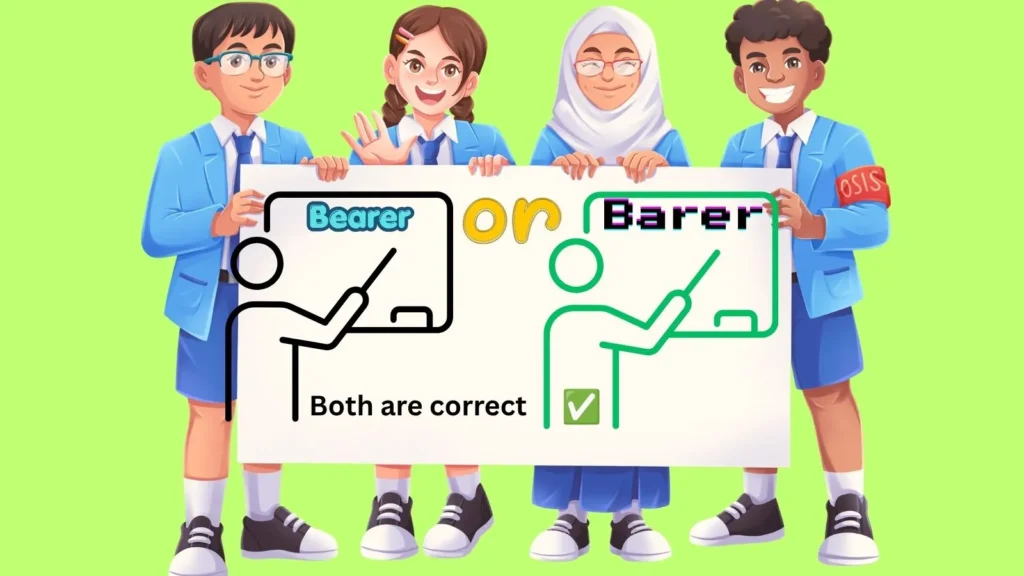
Have you ever seen bearer and barer used in different sentences and wondered which one is correct? You’re not alone. These two words look almost identical, but they have completely different meanings.
Quick answer:
Bearer refers to a person or thing that carries, delivers, or possesses something, while barer means someone or something that makes something bare or more exposed.
For example:
- ✅ The bearer of the award smiled proudly.
- ✅ The trees became barer after the storm.
Many English learners confuse these words because they come from similar-looking spellings. However, knowing the difference will help you write more accurately in emails, school assignments, social media posts, and everyday conversations.
You’ll learn the meaning of bearer or barer, their origins, correct usage, common mistakes, practical examples, and simple rules to remember the difference forever.
See also: Break Metal or Brake Metal: Understanding the Correct Usage
Table of Contents
- Bearer or Barer: Quick Answer
- What Does Bearer Mean?
- What Does Barer Mean?
- Origin and History
- British English vs American English
- Bearer or Barer: Which One Should You Use?
- Common Mistakes
- Everyday Examples
- Usage Trends
- Comparison Table
- Special Rules and Important Uses
- Frequently Asked Questions
- Conclusion
⚡ Bearer or Barer: Quick Answer
| Word | Meaning | Example |
|---|---|---|
| Bearer | A person or thing that carries, delivers, or possesses something | She was the bearer of good news. |
| Barer | Comparative form of bare, meaning more uncovered or less covered | The mountain looked barer in winter. |
Remember:
- Bearer = carries or possesses
- Barer = more bare
What Does Bearer Mean?
The word bearer is a noun. It describes someone or something that carries, brings, holds, or possesses something.
It comes from the verb bear, which means to carry, support, or bring.
Common Uses
A bearer can be:
- The bearer of gifts
- The bearer of news
- The bearer of a message
- The bearer of responsibility
- The bearer of an official document
Correct Examples
- The mail carrier was the bearer of important documents.
- She became the bearer of exciting news.
- The flag bearer led the parade.
- He is the bearer of this certificate.
Incorrect Example
❌ She looked bearer after cutting her hair.
✅ She looked barer after cutting her hair.
What Does Barer Mean?
Barer is the comparative form of the adjective bare.
It means:
- More uncovered
- Less protected
- More exposed
- More empty
Correct Examples
- The trees became barer during autumn.
- His room looked barer after moving out.
- The walls appeared barer without paintings.
- The mountain was barer after the wildfire.
Incorrect Example
❌ The barer delivered my package.
✅ The bearer delivered my package.
Origin and History
Although these words look alike, they come from different grammatical forms.
Bearer
Bearer comes from the Old English verb beran, meaning to carry or bring.
Over time, it developed into a noun referring to someone who carries something.
Examples include:
- Standard-bearer
- Ring bearer
- Torch bearer
- Flag bearer
Barer
Barer comes from the adjective bare, meaning:
- Naked
- Empty
- Uncovered
- Plain
Adding -er creates the comparative form:
- Bare
- Barer
- Barest
Bearer vs Barer: Side-by-Side Comparison
Unlike many English words, bearer and barer have the same meanings in both British and American English.
The spelling does not change.
| British English | American English |
|---|---|
| Bearer | Bearer |
| Barer | Barer |
Only pronunciation may vary slightly depending on the speaker’s accent.
Bearer or Barer: Which One Should You Use?
Ask yourself one simple question.
Is someone carrying, delivering, or possessing something?
Use bearer.
Examples:
- Bearer of gifts
- Bearer of bad news
- Passport bearer
- Flag bearer
Is something becoming more exposed or uncovered?
Use barer.
Examples:
- Barer trees
- Barer walls
- Barer landscape
- Barer branches
Common Mistakes
People often replace one word with the other because they sound similar.
Mistake 1
❌ She became the barer of the award.
✅ She became the bearer of the award.
Mistake 2
❌ The hills looked bearer after the snow melted.
✅ The hills looked barer after the snow melted.
Mistake 3
❌ The barer delivered the invitation.
✅ The bearer delivered the invitation.
Mistake 4
❌ The room became bearer after removing the furniture.
✅ The room became barer after removing the furniture.
Everyday Examples
Emails
✅ Please present this letter to the bearer upon arrival.
Classroom
✅ The student became the bearer of the school’s science trophy.
Daily Life
✅ The garden looked barer after winter pruning.
Usage Trends and Popularity
Bearer is much more common than barer in everyday English.
You’ll frequently see bearer in:
- Legal documents
- Banking
- Certificates
- Sports
- Official announcements
- Ceremonies
Meanwhile, barer mainly appears when comparing physical appearance or describing landscapes, clothing, or objects that are less covered.
Because barer has a narrower meaning, it appears less often in writing.
Comparison Table
| Feature | Bearer | Barer |
|---|---|---|
| Part of Speech | Noun | Comparative adjective |
| Meaning | Person or thing that carries | More uncovered |
| Derived From | Bear | Bare |
| Common Usage | News, gifts, documents, responsibility | Clothing, nature, appearance |
| More Common? | Yes | Less common |
| Example | Bearer of good news | Barer trees |
Special Rules and Important Uses
Use Bearer for:
- Ring bearer
- Flag bearer
- Torch bearer
- Standard bearer
- Bearer cheque
- Bearer bonds
- Bearer of gifts
- Bearer of responsibility
Use Barer when comparing:
- Clothing
- Trees
- Mountains
- Walls
- Rooms
- Landscapes
- Faces
- Skin
Easy Memory Trick
Think of it this way:
- Bearer contains bear, which means carry.
- Barer comes from bare, meaning less covered.
Frequently Asked Questions
Is bearer or barer correct?
Both are correct, but they have different meanings. Bearer refers to someone who carries or possesses something, while barer means more uncovered or exposed.
Is barer a real English word?
Yes. Barer is the comparative form of bare.
Example:
The room became barer after the furniture was removed.
What is a bearer in English?
A bearer is a person or thing that carries, delivers, or possesses something.
Example:
The flag bearer walked at the front of the parade.
Can bearer describe a person?
Yes. In fact, it usually refers to a person.
Examples include:
- Ring bearer
- Torch bearer
- Gift bearer
Why do people confuse bearer and barer?
They are pronounced similarly and differ by only one letter. However, they come from different root words and serve different grammatical roles.
Which word is more common?
Bearer is far more common because it appears in official, legal, financial, and everyday contexts, while barer is mainly used for comparisons involving physical appearance or exposure.
Conclusion
Although bearer and barer differ by only one letter, they serve very different purposes in English. Bearer is a noun that refers to someone or something carrying, delivering, or possessing an item, message, responsibility, or title. Barer, on the other hand, is the comparative form of bare, describing something that is more exposed, uncovered, or empty than before.
A simple way to remember the difference is to connect bearer with the verb bear, meaning to carry. If you’re talking about someone carrying a flag, delivering news, or holding a certificate, bearer is the right choice. If you’re comparing how uncovered or exposed something is, choose barer.
Whenever you’re unsure, ask yourself whether the sentence is about carrying something or being more bare. That quick check will help you choose the correct word every time.