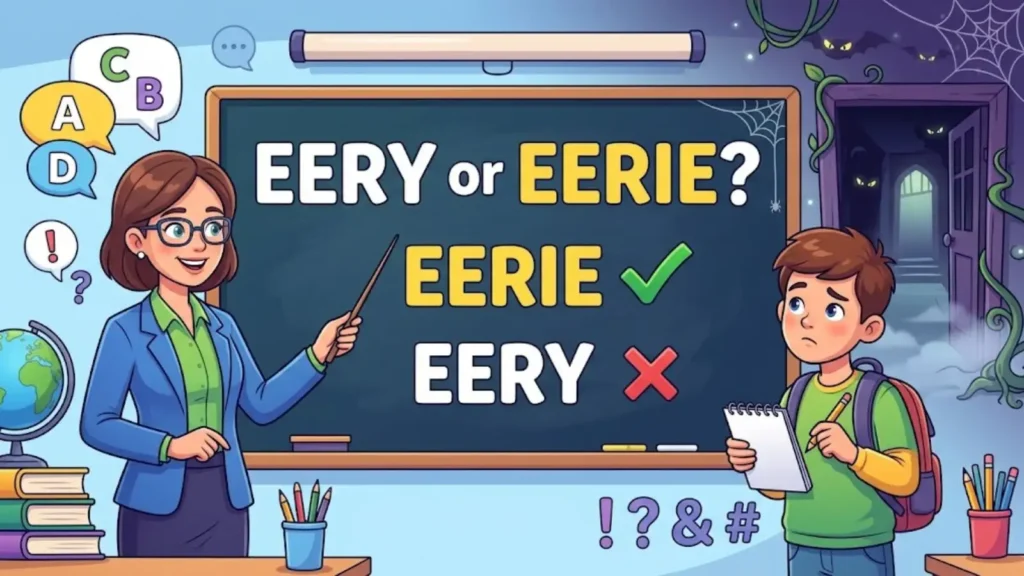
Confused about eery or eerie? You are not alone. This spelling can feel tricky because English often uses double letters in words that do not sound very different. However, there is a clear answer: eerie is the correct spelling in standard English.
Quick Answer – Eery or Eerie?
Eerie is the correct spelling, while eery is generally considered a misspelling.
The word eerie describes something strange, frightening, mysterious, or unsettling. For example, you might describe a quiet, empty house as eerie.
Correct: The old house looked eerie at night.
Incorrect: The old house looked eery at night.
A simple way to remember it is that eerie has two e’s after the initial consonant: e-e-r-i-e.
Meaning of Eerie
Eerie means unusually strange, mysterious, or slightly frightening. It often describes a feeling caused by something unfamiliar, quiet, dark, or unnatural.
For example, an empty playground at midnight may feel eerie. A strange sound coming from an abandoned building can also create an eerie atmosphere.
The word usually describes an abstract quality or feeling, rather than something that can be physically controlled or owned. You can use it for places, sounds, expressions, situations, and experiences.
Simple Examples
- The forest became eerie after sunset.
- An eerie silence filled the room.
- The movie had an eerie atmosphere.
- I heard an eerie sound outside.
Why People Misspell Eerie
People often misspell eerie because English contains many words with confusing double letters. When we type quickly, our brains may focus on pronunciation instead of spelling.
Words such as address, success, and necessary also contain repeated letters that can cause mistakes.
The spelling eery looks reasonable because it is shorter and may seem to match the pronunciation. However, standard English uses eerie, not eery.
Typing quickly can make the problem worse. Your fingers may simply skip one of the repeated letters.
Origin of Eerie
The history of eerie is linked to older forms of English and Scots. It developed from the Scots word eerie, meaning fearful, strange, or causing fear.
Unlike some English words, its history does not come directly from a simple Latin root. It is associated with the Scots and northern English vocabulary that developed over centuries.
The word gradually became established in wider English usage. Today, eerie commonly describes something that creates a mysterious or unsettling feeling.
British vs American English
Fortunately, there is no spelling difference between British and American English here. Both varieties use eerie.
| English Variety | Correct Spelling | Example |
|---|---|---|
| American English | eerie | The room felt eerie. |
| British English | eerie | The room felt eerie. |
| Canadian English | eerie | The forest looked eerie. |
| Australian English | eerie | It was an eerie evening. |
So, whether you are writing for a British or American audience, choose eerie.
When to Use Eerie
You can use eerie in almost any type of writing when you want to describe something strange, unsettling, or frightening.
Essays and Assignments
Students can use eerie when describing a setting, character, story, or event.
The author creates an eerie setting through darkness and silence.
Emails and Work Reports
The word can also appear in professional writing when the context is appropriate.
The empty office created an eerie atmosphere after the power outage.
Legal Documents
Legal writing usually favors precise and formal language. However, eerie can appear when quoting testimony or describing someone’s account.
The witness described the scene as eerie and unusually quiet.
Casual Writing
In everyday conversations, social media posts, and messages, eerie works naturally.
That abandoned building looks eerie at night!
Common Mistakes
The most common mistake is dropping one of the letters in eerie and writing eery.
❌ Incorrect: Eery
The empty street looked eery after midnight.
✅ Correct: Eerie
The empty street looked eerie after midnight.
Another mistake happens when people type too quickly. Because the word contains repeated letters, it is easy to leave one out.
Think of the spelling as a small chain: e-e-r-i-e. Keeping those letters in order will help you avoid the common typo.
Everyday Examples of Eerie
The word eerie appears in many everyday situations. You might use it when describing a movie, photograph, place, sound, or unusual experience.
In Emails
The building was strangely eerie after everyone left.
On Social Media
This abandoned hotel looks seriously eerie!
In Professional Writing
The security team noticed an eerie silence throughout the facility.
In School Assignments
The writer uses darkness to create an eerie mood.
These examples show that eerie works in both casual and formal contexts.
Usage Comparison Table
| Context | Correct Sentence | Incorrect Sentence |
|---|---|---|
| Object/Place | The abandoned house looked eerie. | The abandoned house looked eery. |
| Skill/Description | She described the eerie scene clearly. | She described the eery scene clearly. |
| Legal/Official Context | The witness called the scene eerie. | The witness called the scene eery. |
| Daily Speech | That sound is eerie. | That sound is eery. |
| School Writing | The story has an eerie atmosphere. | The story has an eery atmosphere. |
The pattern is simple: whenever you need this adjective, use eerie.
How to Remember the Spelling
A useful memory trick is to focus on the repeated e sounds in the written word.
Remember:
E + E + R + I + E = EERIE
You can also connect the spelling with the word creepy. Both words describe something that may make you uncomfortable or frightened.
Eerie = strange + unsettling + mysterious
When you remember the meaning and the spelling together, the word becomes easier to recognize.
Eerie vs. Creepy
Although eerie and creepy can sometimes describe similar situations, they are not exactly the same.
Eerie usually emphasizes a strange, mysterious, or unsettling feeling. Creepy often suggests something that makes you feel uncomfortable, nervous, or afraid.
For example:
The empty hallway was eerie.
The man following me was creepy.
An eerie place may feel strange because it is silent or mysterious, while a creepy situation may make you actively uncomfortable.
FAQs About Eery or Eerie
Is eery or eerie correct?
Eerie is the standard and correct spelling. Eery is generally treated as a misspelling.
How do you spell eerie?
The correct spelling is eerie: E-E-R-I-E.
Is eery a word?
Eery is not the standard spelling used in modern English. In normal writing, use eerie.
How can I remember the spelling of eerie?
Remember the sequence E-E-R-I-E. Writing the word slowly once or twice can also help build spelling memory.
Is eerie the same in British and American English?
Yes. Both British and American English use the spelling eerie.
What does eerie mean?
Eerie means strange, mysterious, unsettling, or slightly frightening.
What is an example of eerie?
The eerie silence of the abandoned building made everyone nervous.
Conclusion
When choosing between eery or eerie, always choose eerie in standard English. The word describes something strange, mysterious, unsettling, or slightly frightening.
The spelling may look confusing because it contains repeated letters, but the solution is simple: remember E-E-R-I-E. Whether you are writing an essay, email, report, social media post, or casual message, eerie is the spelling you can trust.
Quick tip: If you are tempted to write eery, pause and remember the extra e. That small letter makes your spelling correct.