Have you ever searched for plushy or plushie and wondered which spelling is correct? You are not alone. Both forms appear online, especially when people talk about soft toys, teddy bears, character toys, and cute collectibles. The confusion becomes stronger because the two words sound almost the same when spoken.
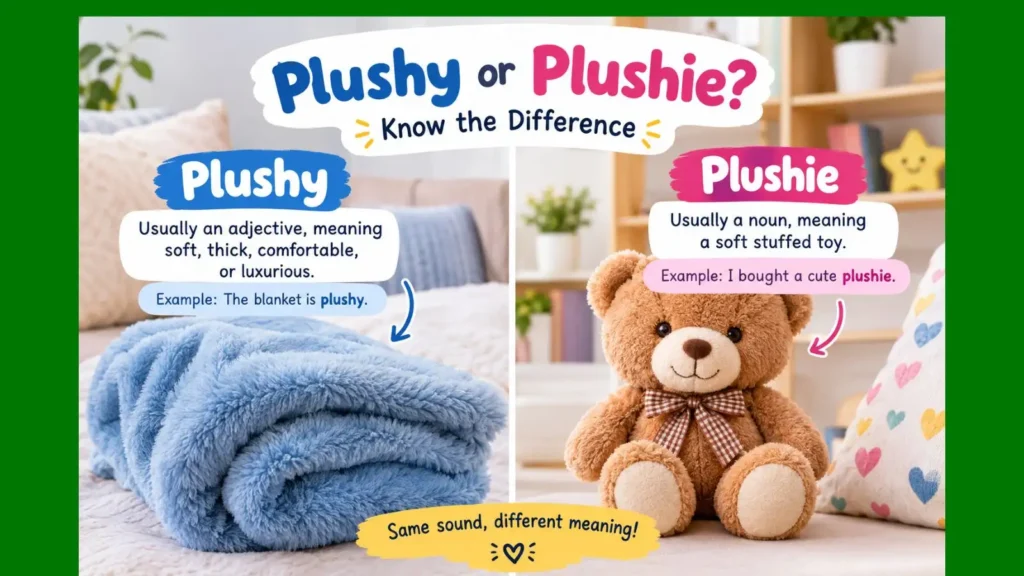
The good news is that the difference is easy to understand. Plushie is commonly used as a noun for a soft stuffed toy. Plushy is usually an adjective that describes something soft, thick, comfortable, or luxurious. However, plushy can also appear as a less common noun for a stuffed toy. Some dictionaries recognize it as a variant of plushie.
This guide explains plushy or plushie, their meanings, origins, spelling differences, common mistakes, and everyday use. It also helps you choose the best form for American, British, and global English.
Plushy or Plushie – Quick Answer
If you mean a soft stuffed toy, plushie is usually the clearest and safest choice.
Plushie is a noun:
- I bought a cute plushie.
- She collects animal plushies.
- My favorite plushie is a small panda.
Plushy is usually an adjective:
- The blanket feels plushy.
- We bought a plushy sofa.
- This fabric has a soft, plushy texture.
However, plushy can also be used as a noun for a soft toy in informal English. Some dictionaries list it as a synonym or variant of plushie.
RELATED: Cosy or Cozy: Which Spelling Is Correct and When to Use It?
Quick Rule
| Word | Common function | Meaning | Example |
|---|---|---|---|
| Plushie | Noun | A soft stuffed toy | I bought a plushie. |
| Plushy | Adjective | Soft, thick, or luxurious | The blanket is plushy. |
| Plushy | Less common noun | A soft stuffed toy | She bought a plushy. |
| Plush | Noun/adjective | Soft fabric or something luxurious | This is a plush toy. |
So, when you are naming the toy itself, plushie is generally the better choice.
The Origin of Plushy or Plushie
Both plushie and plushy are connected to the word plush.
The word plush originally referred to a soft fabric with a thick pile. Over time, it also developed a wider meaning connected with softness, comfort, richness, and luxury.
The adjective plushy developed from plush with the suffix -y. In this form, it means something like “having the qualities of plush.” It can describe soft furniture, fabric, carpets, blankets, and other comfortable materials.
Plushie developed as a casual noun connected with plush toys. The ending -ie gives the word a friendly and informal feeling. This type of ending is common in casual English.
For example:
- plush → plushie
- dog → doggie
- aunt → auntie
The word plushie became especially popular in online communities, toy collecting, gaming, anime fandoms, and social media.
This explains why you can find both spellings online. They developed from the same base word, but their common grammatical roles are different.
British English vs American English Spelling
There is no major British-versus-American spelling rule that changes plushie into plushy.
Instead, the main difference is usage and context.
In American English, plushie is widely understood as a casual word for a soft stuffed toy. Stuffed animal is also very common, especially for animal-shaped toys.
In British English, soft toy and teddy can be very natural choices. However, plushie and plushy are also understood and used.
The important point is that plushie vs plushy is not like color vs colour or center vs centre. The difference is mainly about meaning, grammar, and usage.
| Feature | American English | British English | Global English |
|---|---|---|---|
| Plushie | Common for soft toys | Common and understood | Very clear |
| Plushy | Common as an adjective | Common as an adjective | Understood |
| Plushy as a noun | Informal and less common | Used by some speakers | Less predictable |
| Stuffed animal | Very common | Less common | Widely understood |
| Soft toy | Understood | Very common | Widely understood |
| Plush toy | Common | Common | Very clear |
Therefore, if your goal is clear international writing, plushie or plush toy is usually the safest choice when you mean the toy.
Which Spelling Should You Use?
Your choice depends on what you want to say.
Use “plushie” for a soft toy
If you are talking about a stuffed animal, character toy, or collectible soft toy, plushie is a natural choice.
For example:
I bought a new plushie for my daughter.
His room is full of cute plushies.
This use is especially common in casual online writing, social media, fandom communities, and collecting groups.
Use “plushy” to describe softness
Choose plushy when you want to describe the feel or quality of something.
For example:
The hotel has plushy chairs.
I love this plushy blanket.
The toy has a plushy surface.
Here, plushy describes something rather than naming the object.
Use “plush toy” for formal or professional writing
If you are writing a product description, business page, catalog, or formal document, plush toy can be even clearer.
For example:
Our store sells handmade plush toys for children.
This phrase immediately tells readers what the product is.
Best choice by audience
- US audience: Plushie is a good casual noun.
- UK audience: Plushie works, but soft toy may also sound natural.
- Australian audience: Plushie and soft toy are both understandable.
- Global audience: Plushie or plush toy gives strong clarity.
- Formal business writing: Plush toy is often the safest choice.
- Social media: Plushie sounds friendly and natural.
Common Mistakes with Plushy or Plushie
The biggest mistake is treating plushy and plushie as completely interchangeable.
Mistake 1: Using plushy when you mean the toy
Less clear:
I bought a new plushy yesterday.
Better:
I bought a new plushie yesterday.
Although some speakers use plushy as a noun, plushie is clearer for most modern readers.
Mistake 2: Using plushie as an adjective
Less natural:
I bought a plushie blanket.
Better:
I bought a plushy blanket.
Here, plushy describes the blanket’s soft texture.
Mistake 3: Using the wrong plural
The usual plural of plushie is plushies.
Correct:
She has five plushies.
Incorrect:
She has five plushieses.
Mistake 4: Assuming plushy is always wrong
This is also a mistake.
Plushy is a valid English word. It is commonly used as an adjective meaning soft, thick, comfortable, or plush-like. It can also appear as a noun variant for a soft toy.
Mistake 5: Using “plush” when you need a specific noun
Plush can describe a toy:
She bought a plush toy.
But plushie directly names the soft toy in casual usage.
Plushy or Plushie in Everyday Examples
Knowing the meaning is useful, but seeing real examples makes the difference easier to remember.
In an Email
Casual email:
Hi Sarah,
I found the perfect plushie for your birthday. I think you will love it!
For a business email:
We have added several new plush toys to our children’s collection.
The second version sounds more professional.
In Social Media
Plushie is very natural on social media:
Look at my new plushie! 🧸
My plushie collection keeps growing.
Which plushie should I buy next?
Social media often favors friendly, short, informal words. That makes plushie a natural choice.
In Product Descriptions
A store might write:
This cute bunny plushie is soft, lightweight, and easy to carry.
Or:
This plush toy is made with soft fabric and safe filling.
The word plushy can describe the product’s feel:
The plushy outer fabric gives this toy a soft and cozy feel.
In News Writing
News writing usually favors clear terms such as stuffed toy, plush toy, or soft toy.
Example:
The company launched a new collection of character plush toys.
A casual entertainment article might use:
Fans rushed to buy the new character plushie.
In Formal Writing
For formal writing, avoid using plushie unless the subject specifically involves toys, collectors, or popular culture.
Instead of:
The company manufactures cute plushies.
You could write:
The company manufactures soft plush toys.
This sounds more neutral and professional.
Plushy or Plushie – Google Trends & Usage Data
Search interest can change over time, so Google Trends should be treated as a relative measure of search interest, not as an exact count of searches.
For this keyword pair, the most useful pattern is not simply “one spelling is correct and the other is wrong.” Instead, the terms appear in different contexts.
Plushie is strongly associated with:
- Stuffed toys
- Character toys
- Collectors
- Gaming communities
- Anime communities
- Social media
- Online shopping
Plushy has two major uses:
- Describing something soft or luxurious.
- Informally referring to a soft toy.
Modern online usage often favors plushie when the searcher wants the name of a toy. Industry and language guides also commonly recommend plushie for the noun and plushy for describing texture.
Regional vocabulary also affects searches. American users may search for stuffed animal, while British users may use soft toy. This means search behavior can depend on both spelling and local vocabulary.
For SEO, the best strategy is therefore not to force one word everywhere. Use plushie when discussing the toy, and naturally include related terms such as plush toy, stuffed animal, and soft toy where they fit.
Plushie vs Plushy: Comparison Table
| Point | Plushie | Plushy |
|---|---|---|
| Main role | Noun | Usually adjective |
| Main meaning | Soft stuffed toy | Soft, thick, or luxurious |
| Toy meaning | Very common | Less common |
| Texture meaning | Not usually used | Very common |
| Plural | Plushies | Usually not plural as adjective |
| Social media | Very common | Less common |
| Toy collecting | Very common | Less common |
| Formal writing | Less formal | Useful as an adjective |
| Product naming | Good for toys | Better for texture |
| Safest toy term | Yes | Usually no |
| Example | I bought a plushie. | This blanket is plushy. |
Why Do Plushie and Plushy Sound the Same?
The pronunciation is one of the main reasons people confuse these words.
Plushie and plushy are generally pronounced in almost the same way.
That means you may hear someone say the word and have no idea which spelling they mean.
The difference becomes visible only when the word is written:
- plushie
- plushy
This is why people often search “plushy or plushie” online. They know the word from speech but are unsure which letters to use.
When in doubt, ask yourself one simple question:
Am I naming a toy or describing something soft?
If you are naming the toy, choose plushie.
If you are describing softness, choose plushy.
FAQs About Plushy or Plushie
1. Is “plushie” or “plushy” correct?
Both words can be correct, but they commonly have different uses. Plushie is the clearer choice for a soft stuffed toy, while plushy is usually an adjective describing something soft or luxurious.
2. Is “plushy” a real word?
Yes. Plushy is a real English word. It is commonly used as an adjective meaning soft, thick, comfortable, or plush-like. It can also be used as a less common noun variant for a plush toy.
3. What is the plural of plushie?
The standard plural is plushies.
Example:
I have three plushies on my bed.
4. Can plushy mean a stuffed animal?
Yes. Some speakers use plushy as a noun for a stuffed toy. However, plushie is generally clearer and more widely recognized for this meaning.
5. Is plushie more common than plushy?
For the noun meaning a soft stuffed toy, plushie is generally the more familiar modern form, especially in online communities, collecting, gaming, and social media.
6. Is “plushie” formal English?
Plushie is an informal and friendly word. In formal business or technical writing, plush toy, soft toy, or stuffed toy may be more suitable.
7. Should I use plushie or plushy?
If your page is about a soft stuffed toy, plushie is a strong primary term. You can naturally mention plushy, plush toy, stuffed toy, and related phrases when they fit the topic.
Conclusion: Plushy or Plushie?
The choice between plushy or plushie is easier once you understand how each word normally works. Plushie is the clearest and most common choice when you mean a soft stuffed toy. It is especially popular in casual speech, social media, online shopping, fandoms, and toy-collecting communities.
Plushy, on the other hand, is most often an adjective. It describes something that feels soft, thick, comfortable, or luxurious. For example, you can have a plushy blanket, plushy sofa, or plushy fabric. Some people also use plushy as a noun for a soft toy, and dictionaries recognize this usage as a variant.
The simplest rule is: plushie names the toy; plushy usually describes how something feels.

Hi, I’m Alex Reed, the voice behind Grammar Meaning! I simplify English grammar into easy lessons. I write for basicsgrammar.com to help you improve daily writing.