Quick Answer – Through or Thru
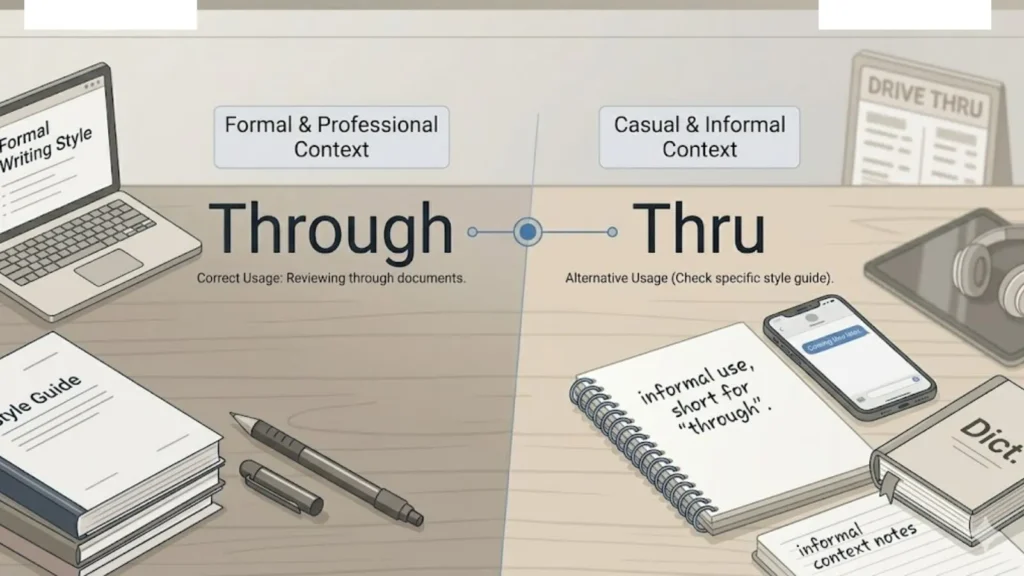
The correct and standard spelling is “through”, while “thru” is an informal, shortened version. Use “through” in formal writing like essays, emails, and reports. Reserve “thru” for casual contexts, such as signs (e.g., drive-thru) or text messages.
Meaning of Through or Thru
The word “through” means moving from one side to another, completing something, or continuing over time. It can describe physical movement, process completion, or abstract progress.
- Movement: “She walked through the tunnel.”
- Completion: “He got through the exam.”
- Skill/effort: “Success comes through practice.”
The informal “thru” carries the same meaning but lacks professionalism. Think of “through” as the complete and polished form, while “thru” is a shortcut.
Why People Misspell Through or Thru
Many people prefer “thru” because English spelling can feel inconsistent. Words with silent letters or complex patterns often get simplified.
For example:
- “address” (double “d” and “s”)
- “success” (double “c” and “s”)
Similarly, “through” looks long and irregular, so people shorten it to “thru” when typing quickly. This habit is common in texting, branding, and signage.
Origin of Through or Thru
The word “through” comes from Old English “þurh”, meaning “from end to end.” It has roots in Germanic languages, not Latin, but evolved over centuries into its modern form.
The spelling “thru” appeared much later, mainly in American English as a simplified spelling in the 19th–20th century. It gained popularity in advertising and road signs for convenience.
British vs American English
Interestingly, both British and American English prefer “through” in formal writing.
| Usage Type | British English | American English |
|---|---|---|
| Formal writing | through | through |
| Informal writing | rarely “thru” | sometimes “thru” |
| Road signs | through | thru (common) |
So, “through” is universally accepted, while “thru” is limited and informal.
When to Use Through or Thru
Use “through” in all professional and academic contexts:
- Essays and assignments
- Emails and reports
- Legal documents
- Business communication
Use “thru” only in casual writing:
- Text messages
- Social media
- Informal notes
Example:
- Formal: “We worked through the night.”
- Casual: “Let’s go thru the plan quickly.”
Common Mistakes
People often misuse “thru” in formal writing or confuse spellings due to speed typing.
| Incorrect Sentence | Correct Sentence |
|---|---|
| I read it thru. | I read it through. |
| Go thru the file. | Go through the file. |
Mistakes happen when:
- Typing too fast
- Trying to simplify spelling
- Copying informal usage into formal writing
Always double-check your writing for professionalism.
Everyday Examples
Here’s how “through” fits into daily life:
- Email: “Please read through the document.”
- Social media: “Scrolling through my feed.”
- School: “She worked through the assignment.”
- Office: “We went through the report together.”
Even in casual settings, “through” still sounds more polished than “thru.”
Usage Comparison Table
| Context | Incorrect (Thru) | Correct (Through) |
|---|---|---|
| Objects | Walk thru the door | Walk through the door |
| Skills | Learn thru practice | Learn through practice |
| Legal terms | Payment thru contract | Payment through contract |
| Daily speech | Drive thru the city | Drive through the city |
FAQs
1. Is “thru” ever correct?
Yes, but only in informal contexts like signs or texting. Use “through” for formal writing.
2. How can I remember the correct spelling?
Think of “through” as the complete version. Formal writing needs the full word.
3. Why is “thru” used in drive-thru?
It’s shorter and easier to read quickly on signs.
4. Is “thru” acceptable in academic writing?
No, always use “through” in essays and assignments.
5. Do British people use “thru”?
Rarely. They strongly prefer “through.”
6. Is “through” difficult because of silent letters?
Yes, the spelling includes silent letters, which makes it look complex.
7. Can I use both in the same document?
Avoid mixing them. Stick with “through” for consistency.
Conclusion
The difference between “through” and “thru” is simple: one is formal and correct, the other is informal and shortened. Always use “through” in professional, academic, and official writing. Save “thru” for casual use only.
A helpful tip: when in doubt, choose the longer form. It shows clarity, professionalism, and attention to detail.

Hi, I’m John Miles, the voice behind Grammar Meaning! I share clear and practical grammar tips. You’ll find my work on basicsgrammar.com.